Eating Outside in Dubai, and Why It Took Us This Long to Get It Right
The first time I understood the season
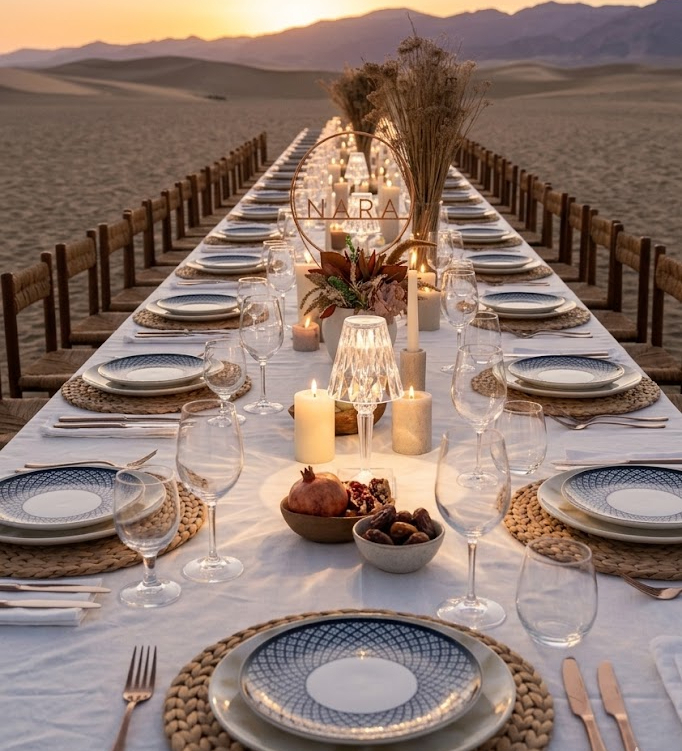
The first time outdoor dining in Dubai made sense to me — not as a concept but as something I felt in my chest — was a December evening at a table set on sand. It was just after seven. The temperature had dropped to twenty-three degrees, and the air had that particular weight it carries in the desert when the sun is gone but the earth is still warm. There was no wall between me and the horizon. No glass. No railing. Just a table, a plate of lamb that had been cooking slowly since afternoon, and a silence so complete I could hear the person next to me swallow their wine.
I had lived in this city for years by then. I had eaten on terraces with misting systems in September, sweating through courses I could not taste because my body was busy surviving. I had done rooftop brunches in May where the bread dried out between the basket and my plate. I had confused proximity to the outdoors with actually being outside.
That December night was different. The wind came from the east, slow and cool, carrying nothing. The sky had already turned from copper to ink. The food was good — it is almost always good when the kitchen has room to breathe — but what I remember is the temperature. Twenty-three degrees at seven in the evening. The kind of air that makes you sit back in your chair and stay.
That was the first time I understood that Dubai does not have a dining season. It has a reprieve.
Seven months of waiting
From April to October, Dubai folds inward. Restaurants seal their terraces. Hotels retract their poolside menus. The city, which markets itself on spectacle and openness, spends more than half the year behind glass. The heat is not an inconvenience, it is an erasure. At forty-six degrees, the question of eating outside does not come up. You do not weigh the pros and cons. In this case you simply do not go.
This compression does something to you. By the time October comes and the air starts to thin, there is an urgency that people in temperate cities never feel. The first cool evening is not casual. It is an event. Restaurants that have been half-empty suddenly cannot seat you. Terraces fill before the dining room. People stand on balconies with their morning coffee for the first time in seven months, and they stand there longer than they need to.
The season is not long. November through March – five months if you are generous, four if you are honest. And that brevity is exactly what makes it matter.
What the desert does to a meal
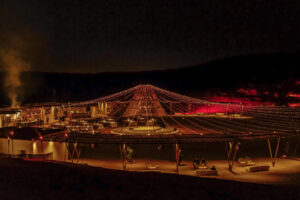
There is a moment at Sonara Camp, maybe forty minutes before sunset, when the kitchen begins to work and the smoke rises straight up because there is no wind yet. The camp sits inside the Dubai Desert Conservation Reserve, far enough from the highway that you cannot hear it, far enough from the city that you cannot see it. The kitchen operates kilometres from the nearest permanent structure. Everything – the ovens, the cold storage, the prep stations – has been brought here, assembled on sand, and will perform as though it were not absurd to cook a five-course dinner in the middle of a desert.
That absurdity is part of it. Eating well in a place that offers nothing – no infrastructure, no shelter, no audience – forces a kind of attention that a city restaurant cannot. You notice the food because there is nothing else to notice. The lamb shoulder, pulled apart at the table, tastes the way it tastes because the air is dry and still and carries the smoke directly to you before the fat has cooled. The bread, charred on one side from an open flame, is warm in your hands in a way it never is when it arrives on a plate carried from a kitchen down a hallway through a swinging door.
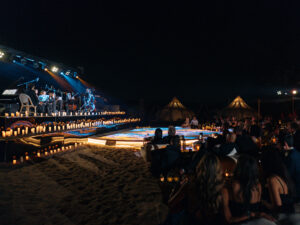
This is one of the more honest unique dining experiences Dubai has produced. Not because it is more expensive or more exclusive, but because the desert strips away the architecture that usually separates you from your meal. There are no walls to absorb sound, so conversation carries. Laughter from three tables away reaches you intact. The clink of a glass is specific, not muffled.
During dinner, when the lights dim, you look up. The stars in the Conservation Reserve are not the stars you see from a Dubai rooftop. They are brighter, denser, older-looking, indifferent. The meal is over, but the desert is not finished with you.
What the sea does to a meal
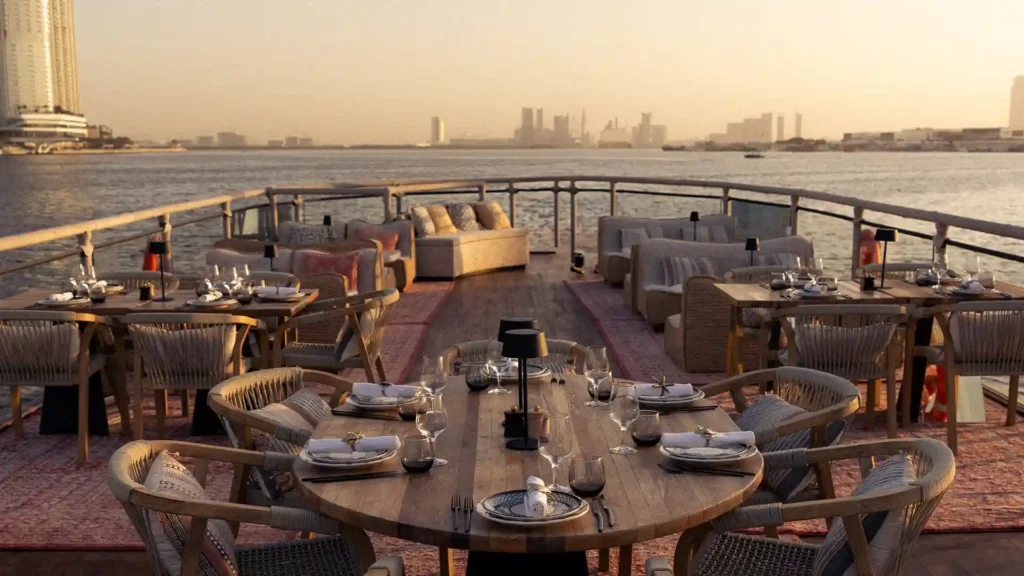
A meal on Lady Nara begins before you sit down. It begins when the dhow pulls away from the marina and the skyline starts to move. The Burj Khalifa, which from land is a fixed point you stop noticing, becomes a thing that drifts. It slides behind the Frame, reappears between two towers you have never paid attention to in Business Bay, and eventually settles into a silhouette that looks nothing like the postcard. The city rearranges itself for you, and you have not yet been handed a menu.
Water changes the contract between a diner and a meal. On land, you sit still and the food comes to you. On the Gulf, everything is in motion — the boat, the skyline, the light on the surface, your own centre of gravity making micro-adjustments you are not aware of until you reach for your glass and find it has shifted two centimetres to the left. This is not disorienting. It is engaging. Your body is involved in the meal in a way it usually is not.
The salt air does something to flavour. I have no scientific explanation for this, only repetition. A gin and tonic on the deck of a yacht in the Arabian Gulf tastes different from the same gin and tonic at a bar. Sharper. Colder, even when it is not. The seafood — grilled prawns, sea bass with skin that crisps in the open air — carries the environment into the plate. You taste the place.
This is, in the most literal sense, the best dining experience Dubai offers from the water: a city you thought you knew, seen from a distance that makes it new, while you eat food that has been improved by the simple fact of where you are eating it. The wind is constant. The light, reflected off the Gulf, is different every fifteen minutes. Nothing is controlled, and nothing needs to be.
The restaurants are not the point
If you search for the best outdoor restaurant Dubai has to offer, you will find lists. Dozens of them. They will rank terraces by view, by price, by Instagram performance. They will tell you where to sit, what to order, which angle to photograph. They will treat the restaurant as the destination and the outdoors as the backdrop.
They have it backwards.
The best outdoor dining happens at the collision between food and place — when the setting is not decoration but ingredient. A restaurant in the desert is not a restaurant with a desert view. It is a restaurant that the desert has altered. The silence, the temperature, the distance from everything familiar — these change what the food means. A restaurant on the water is not a restaurant with a sea breeze. The motion, the salt, the shifting horizon — these are part of the menu.
Dubai is specific. It is not a Mediterranean coast where outdoor dining is a default. It is not a tropical island where the weather permits it year-round. It is a city that earns its outdoor season through months of enforced patience, and that specificity — the compression, the relief, the intensity of a short window — is what makes eating outside here feel different from eating outside anywhere else.
The best outdoor restaurant in Dubai is not a single address. It is whatever table, in whatever setting, on whatever evening the air finally cooperates and the food meets the place halfway.
When to go (and when not to)
The core season runs from November through March. These are the months when you can sit outside at seven in the evening without thinking about the temperature, because the temperature is not asking anything of you. December and January are the centre — evenings around twenty to twenty-three degrees, the air dry and still, the light at golden hour lasting long enough to mean something.
October and April are shoulder months, and they require strategy. Early October evenings can still hold thirty degrees at sunset. Late April can surprise you with a cool night, but you are gambling. The desert is best from November to February, when the temperature drops sharply after sunset and the stars are at their clearest — the kind of outdoor restaurants Dubai with a view that no architect can design. The sea is best in December and January, when the Gulf is calm and the wind is present but not aggressive. The city works any time the season is open, but peaks in January, when the tourist energy and the cool air converge.
If you are choosing one month, choose January. If you are choosing one evening, choose a Thursday. The city exhales on Thursday evenings, and the outdoor tables fill with people who look like they have been waiting all week to sit exactly where they are sitting.
What outdoor dining in Dubai will look like in five years
The desert will still be there. The Gulf will still be there. The season will still be short, and that compression will still do its work on the people who live here.
What will change is the ambition. Restaurants are already moving further into the desert, deeper into the Conservation Reserve, further from the marina into open water. The Nest has already extended the desert experience past dinner and into the morning — you sleep in the dunes and wake to a silence that makes the previous night feel like a memory you are still inside. Others will follow. The line between dining and dwelling will continue to blur.
Five years from now, the lists will be longer. The terraces will multiply. The views will get more dramatic. But the thing that makes outdoor dining in Dubai what it is — the heat you survived to get here, the cool air you waited seven months to feel, the meal that tastes the way it tastes because of where you are — that will not change.
Some things about a city are structural. The season is one of them.
Frequently Asked Questions
When is the best time for outdoor dining in Dubai?
The best months for outdoor dining in Dubai are November through March, with December and January as the peak. During these months, evening temperatures range from twenty to twenty-four degrees Celsius — comfortable enough to sit outside for hours without air conditioning or misting systems. October and April are shoulder months where some evenings work and others do not, depending on the weather that week. For desert dining, November through February offers the most dramatic temperature drop after sunset and the clearest night skies. For yacht dining on the Gulf, December and January provide the calmest seas and the most comfortable wind. City terraces are enjoyable throughout the full November-to-March window.
Which outdoor restaurants in Dubai have the best views?
The answer depends on what you consider a view. Sonara Camp, located inside the Dubai Desert Conservation Reserve, offers an uninterrupted horizon of dunes with no buildings, roads, or artificial light. The kind of view that changes minute by minute as the sun sets and the stars appear. Lady Nara provides a moving view of the Dubai skyline from the Arabian Gulf, where the city rearranges itself as the dhow travels. The most honest answer is that the best views in Dubai outdoor dining are not skyline panoramas from the seventy-second floor. They are ground-level encounters with the desert, the sea, or the street.
Are there outdoor restaurants in Dubai suitable for families?
Yes. Desert dining at Sonara Camp works well for families with older children who can appreciate the quiet and the scale of the setting — younger children may find the silence and the distance from familiar surroundings challenging. Dhow cruise and yacht dining on Lady Nara is best suited to older children and teenagers who are comfortable on water. For families with young children, the city terrace is the safest choice: accessible, stimulating, and forgiving of restlessness.
What makes outdoor dining in Dubai different from other cities?
Two things. First, the season is compressed. Dubai offers only four to five months of genuinely comfortable outdoor dining, compared to eight or nine in Mediterranean or tropical cities. That compression creates urgency — residents treat outdoor meals as events, not defaults. Second, the range of settings is extreme. Within a single city, you can eat dinner on a sand dune in a nature reserve, on the deck of a yacht in the Arabian Gulf, or at a street-side table in a busy neighbourhood. Few cities offer that variety of landscape within such a short drive. The combination of scarcity and range makes outdoor dining in Dubai feel more deliberate and more valued than in places where it is available year-round.
Sonara Camp, Lady Nara, and The Nest are open for the season. The Journal publishes new stories every week.