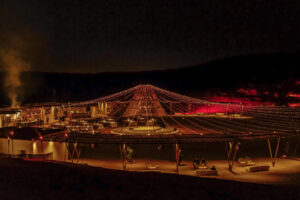
A Table for Two, Surrounded by Nothing
The sun is low enough to touch. It sits on the horizon like something molten, pouring gold across the sand, and the two of them are walking toward a table that has no business being here — white linen, tall candles already lit, two chairs angled not toward each other but toward the last light of the day. There is no host stand. No corridor. No elevator up to a rooftop. Just sand, compacted and cool where the shadow falls, and then this: a table set for two in the open desert, half a kilometer from the nearest wall of any kind.
The candles do not flicker the way they do inside a restaurant. Out here, they lean. The wind comes from the south and carries nothing – no traffic, no music from a neighboring venue, no conversation that is not theirs. The air smells faintly of something dry and warm, the way stone smells after a long day in the sun.
She sits down and looks at the horizon. He sits across from her and says nothing, because there is nothing to say yet. The light is doing all the work. It moves from gold to copper to a violet so deep it looks like bruising, and then the sky opens above them — wider than any ceiling, darker than any dimmed dining room — and the first stars show up like someone is turning them on, one by one, to see if anyone is watching.
They are watching.
I have spent more evenings than I can count in settings like this, and the thing I always notice is the posture. Inside a restaurant, people sit up. They perform. Out here, within minutes, they lean back. They breathe differently. Something about the absence of walls — the understanding that there is nothing between you and the edge of the visible world — changes the way people hold their bodies. It changes the way they talk to each other.
The most romantic dinners I have ever witnessed did not happen in restaurants. They happened where there was the least between two people and the sky.
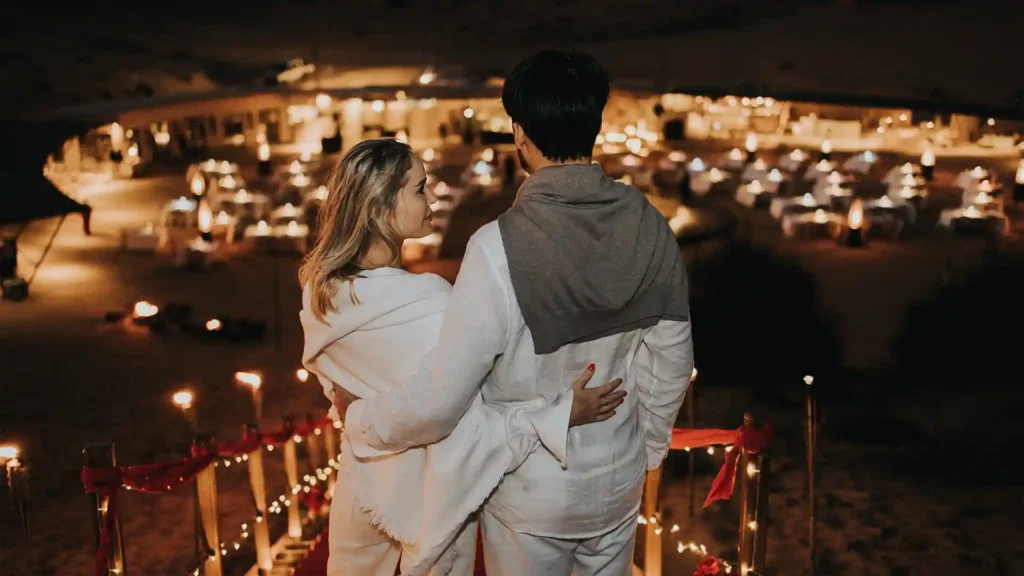
What “Romantic Dinner” Actually Means in Dubai
Dubai does not lack for impressive restaurants. The city has assembled one of the most ambitious dining scenes on the planet — celebrity chef outposts stacked along the marina, rooftop bars with engineered views, hotel lobbies where the lighting alone cost more than most apartments. You can eat Peruvian-Japanese fusion sixty stories above the Palm or have truffle shaved onto your pasta by someone whose name you recognize from television. None of this is in question. Dubai does spectacle extremely well.
But in this case, spectacle is not romance.
I say this as someone who has eaten at most of those places and enjoyed them thoroughly. They are excellent for birthdays with large groups, for impressing clients, for the kind of evening where you want to feel the energy of a city firing on all cylinders. They are not, however, where I would take someone if the point of the evening was the person sitting across from me.
Romance requires one thing that most restaurants cannot provide: the absence of an audience. A romantic dinner in Dubai — the real kind, the kind you are still thinking about three years later — is not defined by what is on the table. It is defined by what is not around it. No neighboring couple close enough to overhear. No waiter arriving at the exact wrong moment. No ambient playlist pitched at the precise volume where you can hear it but cannot ignore it.
When I ask couples what they remember about their best evenings together, they never mention the appetizer. They mention the silence between courses. The way the light changed. The feeling that the world had, for a few hours, narrowed to exactly two people.
The best romantic dinner in Dubai shares that quality with every other truly romantic dinner I have encountered, whether in Lisbon or Kyoto or a backyard in the countryside. It removes everything between two people and the moment. The difference in Dubai is that the landscapes available for that removal — the desert, the open sea, the night sky without light pollution — are extraordinary.
When the Desert Becomes the Dining Room
The drive takes about forty-five minutes. That matters more than you think.
You leave the city — the glass, the cranes, the six-lane highways — and at some point the asphalt narrows and the buildings disappear and there is only sand on both sides of the road, sculpted into shapes by wind that has been working at it for longer than Dubai has existed. The transition is not gradual. It is more like crossing a border. One moment you are in a city of three million people, and the next you are in a landscape that contains, as far as you can see, no one.
This is the drive to Sonara Camp, and the drive itself is part of the experience, because by the time you arrive, you have already left behind the version of yourself that checks a phone, that notices what other people are wearing, that keeps half an eye on the room. The desert does not allow for that. It is too empty, too large, too indifferent to anything but the light.
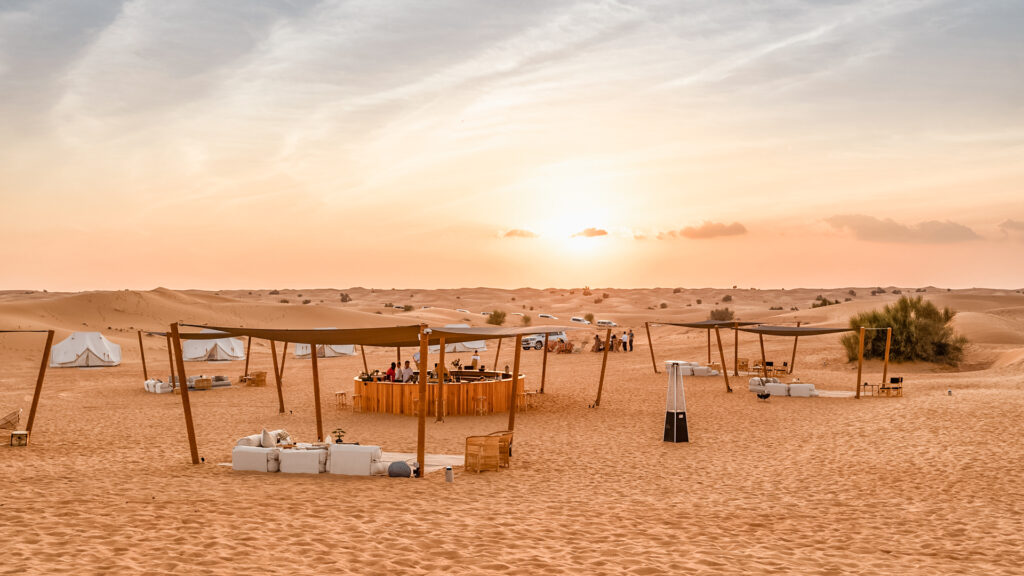
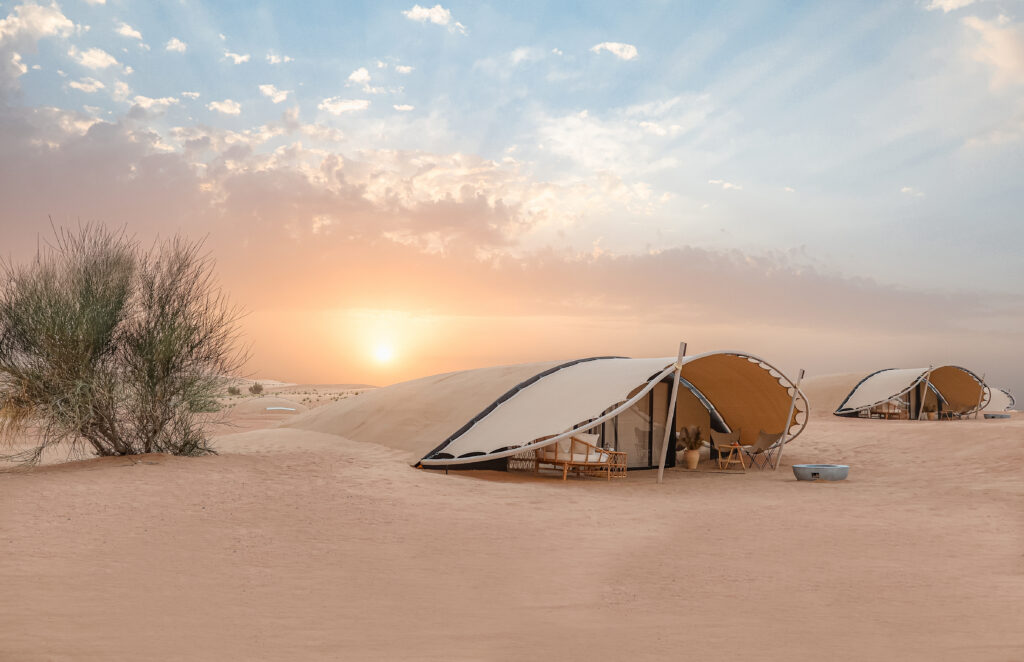
You arrive as the sun begins its last hour. The camp is set into the dunes — low structures, natural materials, nothing that interrupts the horizon line. Candles are already burning. The staff moves quietly. There is food being prepared that you can smell before you see — something grilled over open flame, herbs you cannot quite name.
But the food, I have to be honest, is not the point. The food is good — thoughtful, seasonal, presented with care. But the point is the room. The room is the desert at golden hour, and it is the most beautiful room on earth. The sand catches light differently as the minutes pass — amber, then rose, then something close to lavender — and then the sun drops below the dune line and the temperature shifts, just enough that you notice the air on your arms, and the candles become the only light for kilometers in every direction.
The sunset or candle light dinner in Dubai takes on a different meaning when the candle is not competing with downlights, Edison bulbs, neon signage, the blue glow of someone else’s phone. Out here, a single flame or the Sun turn into the center of the world. You lean toward it. You lean toward each other.
The silence is the part that surprises people. Not silence as the absence of sound — the desert has sound, the wind moving over sand makes a low, continuous whisper — but silence as the absence of intrusion. No one is going to come to your table to ask if everything is all right. Everything is all right. You can tell by looking at the sky.
The Sea at Night — A Different Kind of Silence
If the desert is about stillness, the sea is about something else: a rhythm. The gentle pitch of the deck beneath your feet, the water slapping the hull in a pattern that is almost regular but never quite predictable, the way the city skyline slides past so slowly you only notice it has moved when you look up from your glass.
Lady Nara is not what most people picture when they hear “yacht dining.” There is no thumping bass, no bottle service, no crowd on the upper deck performing for each other’s Instagram stories. It is a vessel, and it is beautiful, and on a given evening it belongs entirely to you.
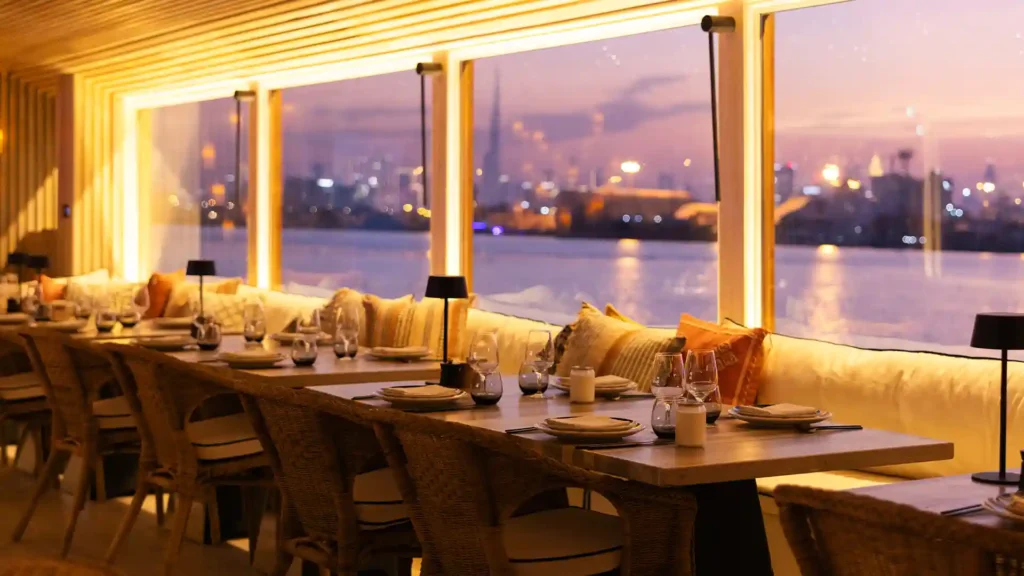
The deck is set for dinner. The lights are low — warm enough to see each other’s faces, dim enough that the skyline behind them matters. The Burj Khalifa is there, and the Marina towers, and the long curve of the JBR coastline, all of it reduced to a strip of light along the horizon. From the water, the city looks like a photograph of itself. It is present but unreachable. You could not get to it quickly if you wanted to, and that distance — that thin skin of dark water between you and everything else — is precisely the point.
Private dining on the water does something to a conversation that a restaurant cannot. The slight movement of the boat requires a different kind of attention. You notice your body more. You hold your glass a little more carefully. You look up from your plate more often, because the view is not fixed — it is drifting, shifting, revealing a new angle of the coastline every few minutes. And because the deck belongs to you, there is no one else’s evening to navigate around. No one squeezing past your table. No one’s chair backing into yours.
The Arabian Gulf at night is not dramatic. It does not crash against rocks or throw spray into the air. It is dark, and warm, and quiet. The water reflects the city in long broken lines of gold and white. The air is salt and diesel and something faintly floral that I have never been able to identify. And the two of you are floating on it, unhurried, uninterrupted, with nowhere to be except exactly where you are.
Some Celebrations Deserve More Than One Night
There are evenings that are complete in themselves — a dinner, a sunset, a drive home with the windows down. And then there are occasions that deserve a longer arc. A proposal. A milestone anniversary. A birthday that closes one decade and opens another. These are not two-hour experiences. They are stories, and stories need a beginning, a middle, and a morning after.
The Nest by Nara exists for those occasions. It is an overnight desert experience — a night under canvas, set deep in the dunes, where dinner is not the destination but the first act.
The evening begins the way any desert evening begins: with the light. You arrive, you settle in, you watch the sun do what it does out here, which is put on a show that would be embarrassing if it were not so sincerely beautiful. Dinner is served. The stars come out. And then, instead of the drive back to the city, instead of the transition from sand to asphalt to elevator to hotel room, you stay.
You stay, and the desert changes around you. The temperature drops. The stars intensify — not slowly, but in waves, as if someone is adjusting the contrast. The silence deepens into something you can almost feel against your skin. And then you sleep, with the desert outside and the canvas above and the sound of absolutely nothing except whatever the two of you are whispering to each other.
Romantic private dining in Dubai usually ends when someone calls the car. At The Nest, it does not end. It transitions. Dinner becomes stargazing. Stargazing becomes sleep. Sleep becomes morning.
And the morning — I need to tell you about the morning. The desert at sunrise is a completely different landscape than the one you saw at sunset. The light comes in flat and pink and impossibly gentle, and the dunes throw long shadows that look like they were drawn there. You sit with coffee in your hand and watch the day arrive, and there is a quality to it that I can only describe as private. The city is waking up somewhere behind you, forty-five minutes and a hundred years away. But here, this morning belongs to you.

The Private Table — Why Intimacy Is the Real Luxury
There is a thread running through the desert and the sea and the overnight experience, and it is not the food, the wine, or the setting — although all three are remarkable. The thread is the absence of other people.
I do not say this to be antisocial. I say it because I have watched enough couples in enough settings to know that the presence of strangers changes everything. In a restaurant, even an excellent one, you are performing your evening in front of an audience. You may not notice them, but your body does. You modulate your voice. You sit a certain way. You are aware, on some level, that your evening is happening alongside thirty other evenings, and that the waiter has a schedule, and that the couple at the next table is having an argument they are trying to keep quiet.
At a private table in the desert, none of this exists. At a private dining setting on the water, none of this exists. Under canvas with the stars overhead, none of this exists. There is just you, the person across from you, and whatever is between you — the good, the complicated, the unspoken, the overdue.
This is not exclusivity as a status symbol. I have no patience for that framing. This is about creating conditions. The conditions for an evening where no one interrupts, no one overhears, no one’s flash goes off at the wrong moment. Where you do not share your evening with anyone except the person you came with.
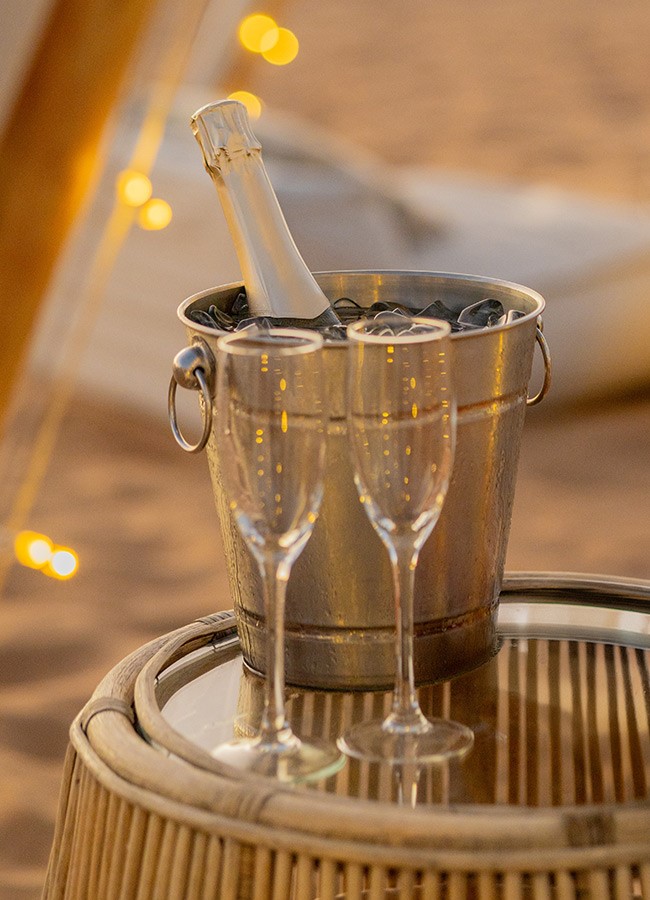
The luxury is not the linen. It is not the champagne, though the champagne is excellent. The luxury is the silence and your own timing. And the understanding that for the next few hours, nothing in the world requires your attention except the person sitting across the table from you.
Planning a Romantic Evening That Actually Surprises
A few things I have learned, from having helped more people plan these evenings than I can count.
Timing matters more than you think. October through April is the season — the air is cool enough to sit outside for hours without wilting, and the light in those months does something extraordinary at sunset that the summer months simply cannot match. If you can, arrive early enough to watch the full transition from afternoon to evening. The sunset is not a backdrop. It is the opening act.
The details can be arranged — flowers, a specific wine, a particular dessert, live music drifting from a distance. I mention these not as a menu of add-ons but as the kind of touches that turn an evening into a story your partner retells. A song they did not expect. A bottle from the year you met. These things matter because they say: I was paying attention.
People search for romantic restaurants in Dubai with a view, and I understand the impulse. But the best view is one without a frame around it. A sunset does not need a window. A skyline is more beautiful from the water than from the forty-second floor.
This works for couples at every stage — a first anniversary, a twenty-fifth, a proposal that someone has been planning for months, or a Tuesday night that has no occasion at all except the desire to sit with someone in a beautiful place and say nothing in particular. Some of those Tuesday nights become the most talked-about evenings of a relationship.
The best private romantic dinner for couples is the one that feels like it was designed for exactly two people. Because it was.
What Stays With You
I ask people, afterward, what they remember. I have been doing this for years, informally, the way you ask a friend how their trip was. And the answers have a pattern.
No one leads with the food (even though the food is spectacular). The food is mentioned — usually the second or third thing — and it is mentioned fondly. But it is not what they remember first.
What they remember first is the sky. Every time. The size of it, the depth of it, the way it changed from hour to hour. In the city, you forget the sky exists. There is too much between you and it — buildings, awnings, ceilings, screens. In the desert, or at sea, the sky is the largest thing in the room. It is above you and around you and so close that on certain nights you feel you could reach into it.
They remember the temperature. The way the air cooled as the evening went on, the exact moment they needed the shawl that was already draped across the chair. They remember the quality of the darkness — not the oppressive dark of a windowless room, but the living dark of a desert night, where the stars provide just enough light to see the outline of the dunes and the shape of the person across from you.
They remember the silence. Not the absence of sound, but the absence of everything that was not the two of them.
And then they go quiet for a moment. And I know, from that silence, that they are back there.
Frequently Asked Questions
What is the most romantic dinner experience in Dubai?
The most memorable romantic dinner in Dubai is one where the setting does the work — where there are no walls, no neighboring tables, and nothing between you and the person you came with. Three experiences stand out for different reasons: a desert dinner at Sonara Camp, where the dunes and the sunset become the room; a private evening aboard Lady Nara on the Arabian Gulf, where the city skyline drifts past at a distance; and an overnight stay at The Nest by Nara, where dinner extends into sunrise. Each suits a different kind of celebration, and the right choice depends on whether you want stillness, movement, or a full evening-to-morning arc.
Can you have a private dinner in the Dubai desert?
Yes — and it is one of the most striking ways to spend an evening in this city. At Sonara Camp, a table is set among the dunes with candles, white linen, and a private chef preparing a multi-course dinner while the sun sets and the stars take over. It is a candle light dinner in Dubai in the most literal sense — out here, the candles are the only light source for kilometers. The experience can be extended overnight through The Nest by Nara, where couples stay under canvas through sunrise, turning a dinner into a complete story.
Where can couples have a romantic private dinner in Dubai?
Three settings offer romantic private dining in Dubai, each with a distinct character. The desert — at Sonara Camp, where the silence and the sunset create an intimacy that indoor restaurants cannot replicate. The sea — aboard Lady Nara, where the gentle movement of the water and the distant skyline produce a different kind of quiet. And the overnight desert — at The Nest by Nara, for occasions that deserve more than a few hours. A private romantic dinner for couples works differently in each setting, and the choice comes down to the kind of memory you want to make.
*If you are planning something that matters — a proposal, an anniversary, a night that you want to remember exactly — we would like to help you find the right setting.*