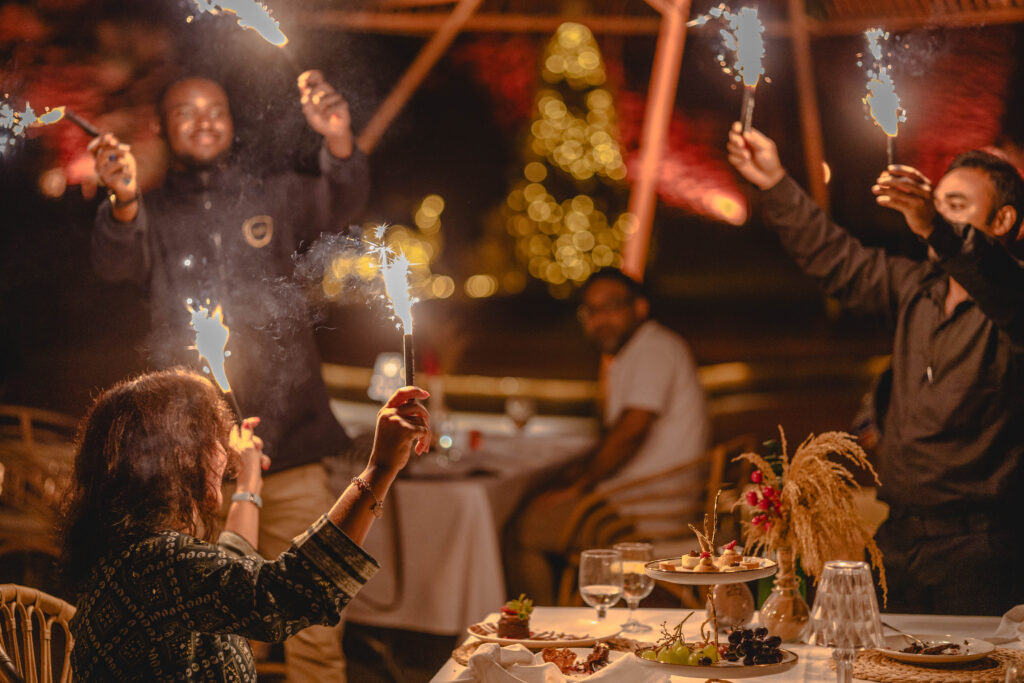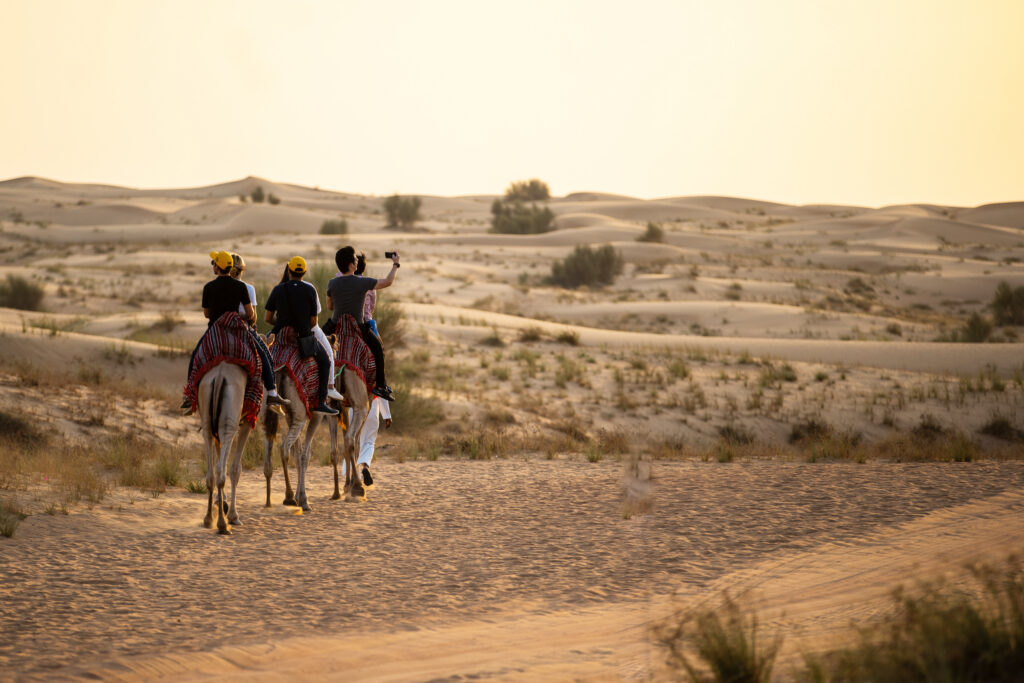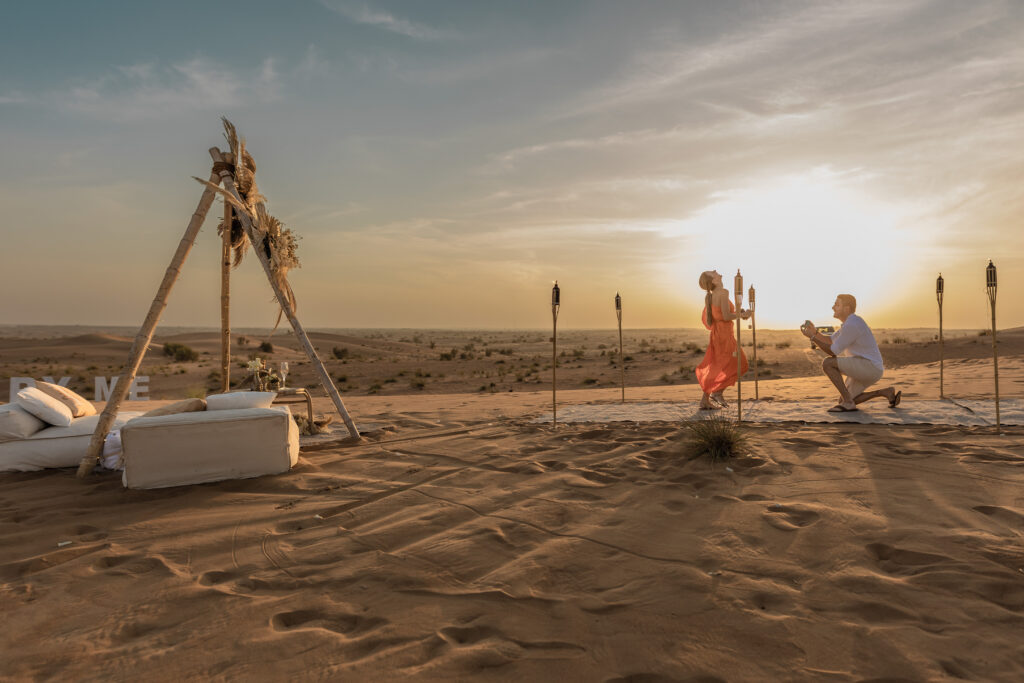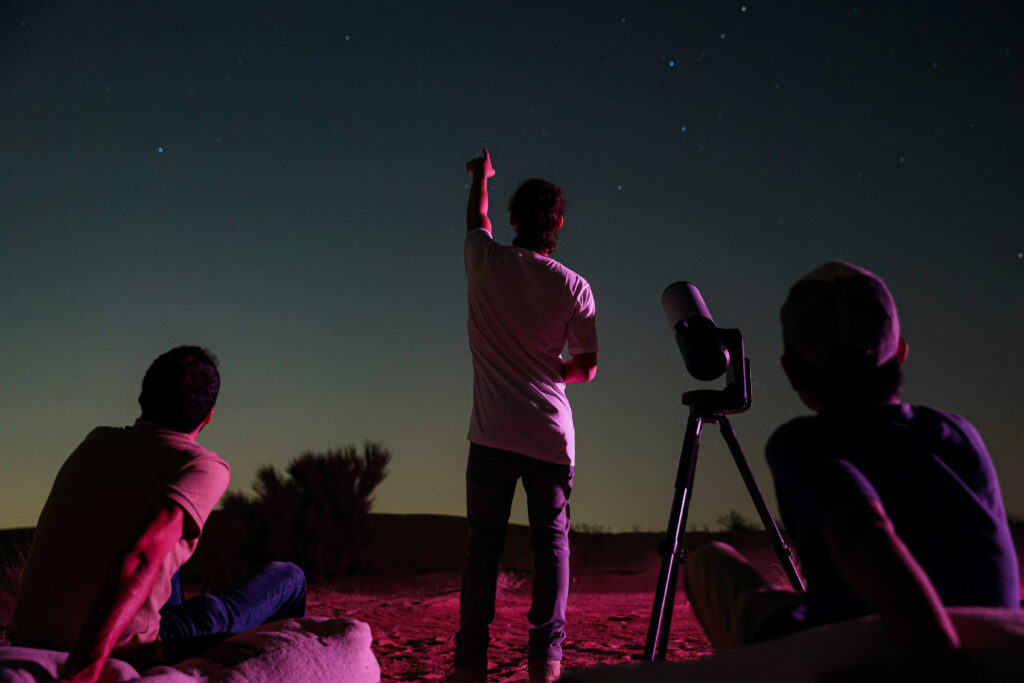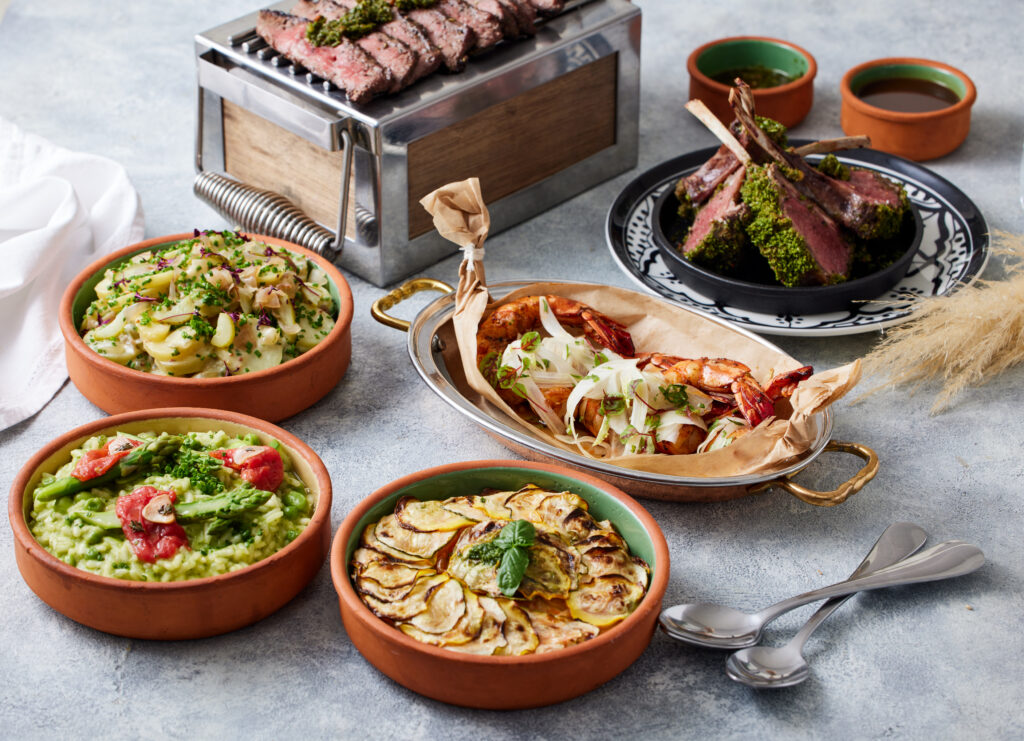
A Table for Two, Surrounded by Nothing

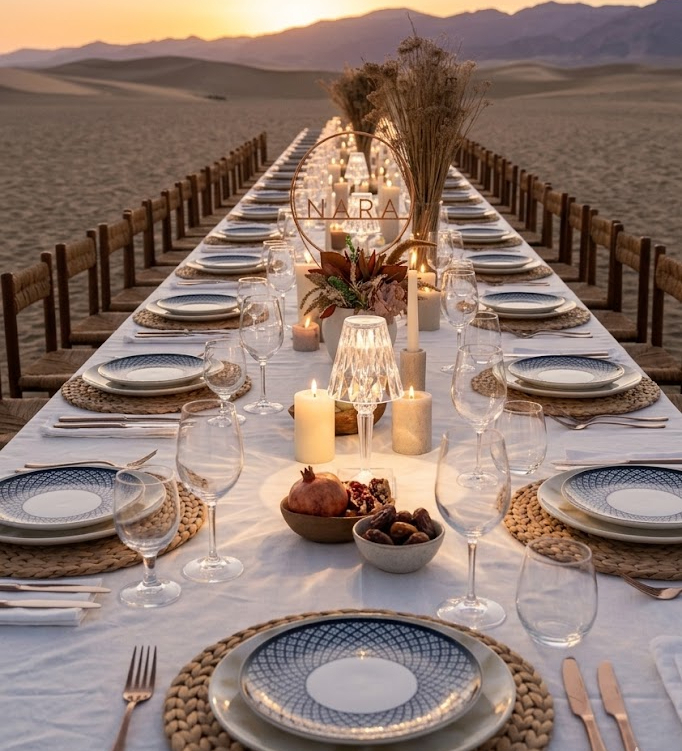
The sun is low enough to touch. It sits on the horizon like something molten, pouring gold across the sand, and the two of them are walking toward a table that has no business being here — white linen, tall candles already lit, two chairs angled not toward each other but toward the last light of the day. There is no host stand. No corridor. No elevator up to a rooftop. Just sand, compacted and cool where the shadow falls, and then this: a table set for two in the open desert, half a kilometer from the nearest wall of any kind.

The candles do not flicker the way they do inside a restaurant. Out here, they lean. The wind comes from the south and carries nothing – no traffic, no music from a neighboring venue, no conversation that is not theirs. The air smells faintly of something dry and warm, the way stone smells after a long day in the sun.

She sits down and looks at the horizon. He sits across from her and says nothing, because there is nothing to say yet. The light is doing all the work. It moves from gold to copper to a violet so deep it looks like bruising, and then the sky opens above them — wider than any ceiling, darker than any dimmed dining room — and the first stars show up like someone is turning them on, one by one, to see if anyone is watching.

They are watching.

I have spent more evenings than I can count in settings like this, and the thing I always notice is the posture. Inside a restaurant, people sit up. They perform. Out here, within minutes, they lean back. They breathe differently. Something about the absence of walls — the understanding that there is nothing between you and the edge of the visible world — changes the way people hold their bodies. It changes the way they talk to each other.

The most romantic dinners I have ever witnessed did not happen in restaurants. They happened where there was the least between two people and the sky.
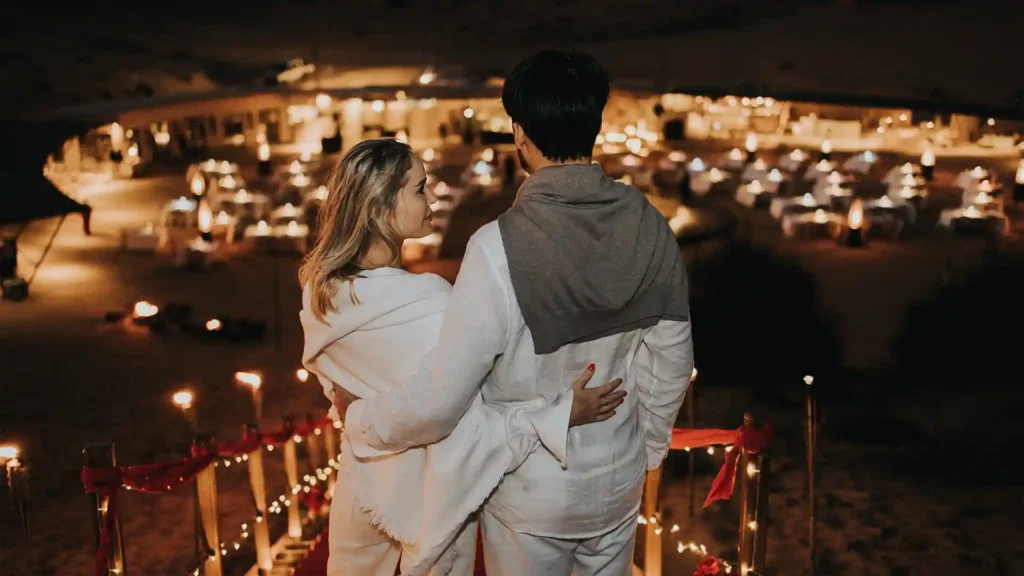
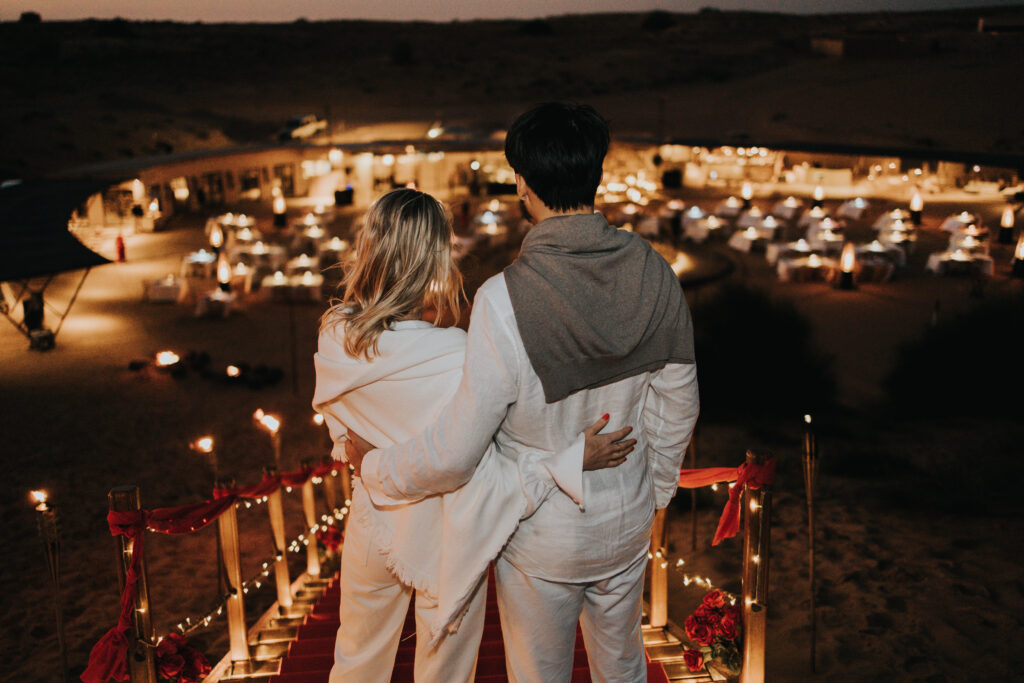
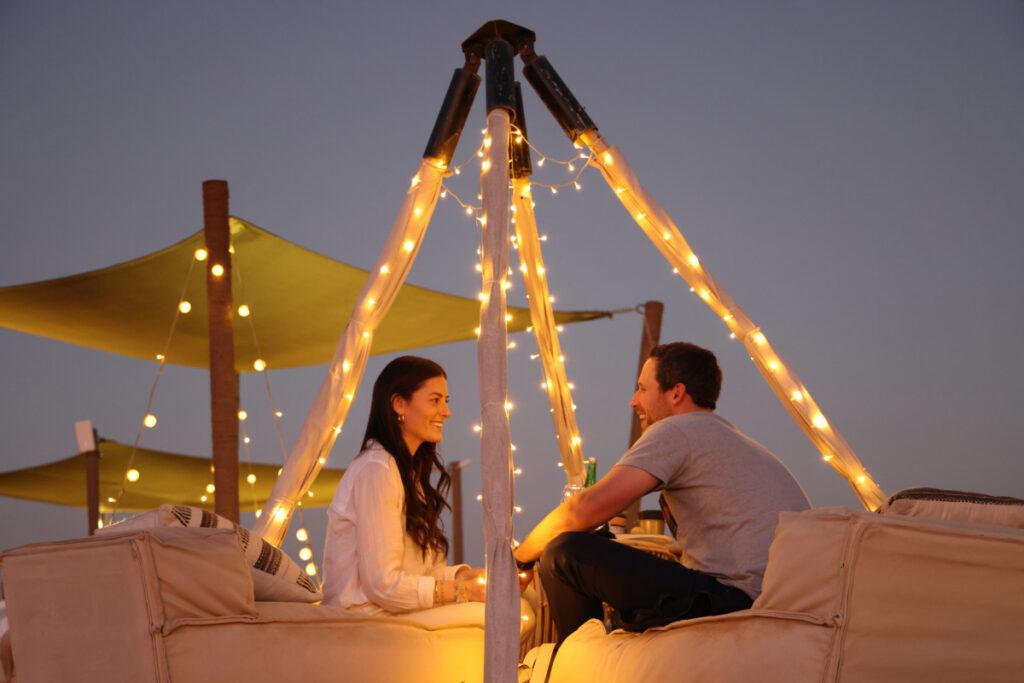
Couple embracing while overlooking a candlelit romantic desert dining setup at night.

What “Romantic Dinner” Actually Means in Dubai

Dubai does not lack for impressive restaurants. The city has assembled one of the most ambitious dining scenes on the planet — celebrity chef outposts stacked along the marina, rooftop bars with engineered views, hotel lobbies where the lighting alone cost more than most apartments. You can eat Peruvian-Japanese fusion sixty stories above the Palm or have truffle shaved onto your pasta by someone whose name you recognize from television. None of this is in question. Dubai does spectacle extremely well.

But in this case, spectacle is not romance.

I say this as someone who has eaten at most of those places and enjoyed them thoroughly. They are excellent for birthdays with large groups, for impressing clients, for the kind of evening where you want to feel the energy of a city firing on all cylinders. They are not, however, where I would take someone if the point of the evening was the person sitting across from me.

Romance requires one thing that most restaurants cannot provide: the absence of an audience. A romantic dinner in Dubai — the real kind, the kind you are still thinking about three years later — is not defined by what is on the table. It is defined by what is not around it. No neighboring couple close enough to overhear. No waiter arriving at the exact wrong moment. No ambient playlist pitched at the precise volume where you can hear it but cannot ignore it.

When I ask couples what they remember about their best evenings together, they never mention the appetizer. They mention the silence between courses. The way the light changed. The feeling that the world had, for a few hours, narrowed to exactly two people.

The best romantic dinner in Dubai shares that quality with every other truly romantic dinner I have encountered, whether in Lisbon or Kyoto or a backyard in the countryside. It removes everything between two people and the moment. The difference in Dubai is that the landscapes available for that removal — the desert, the open sea, the night sky without light pollution — are extraordinary.

When the Desert Becomes the Dining Room

The drive takes about forty-five minutes. That matters more than you think.

You leave the city — the glass, the cranes, the six-lane highways — and at some point the asphalt narrows and the buildings disappear and there is only sand on both sides of the road, sculpted into shapes by wind that has been working at it for longer than Dubai has existed. The transition is not gradual. It is more like crossing a border. One moment you are in a city of three million people, and the next you are in a landscape that contains, as far as you can see, no one.

This is the drive to Sonara Camp, and the drive itself is part of the experience, because by the time you arrive, you have already left behind the version of yourself that checks a phone, that notices what other people are wearing, that keeps half an eye on the room. The desert does not allow for that. It is too empty, too large, too indifferent to anything but the light.

You arrive as the sun begins its last hour. The camp is set into the dunes — low structures, natural materials, nothing that interrupts the horizon line. Candles are already burning. The staff moves quietly. There is food being prepared that you can smell before you see — something grilled over open flame, herbs you cannot quite name.

But the food, I have to be honest, is not the point. The food is good — thoughtful, seasonal, presented with care. But the point is the room. The room is the desert at golden hour, and it is the most beautiful room on earth. The sand catches light differently as the minutes pass — amber, then rose, then something close to lavender — and then the sun drops below the dune line and the temperature shifts, just enough that you notice the air on your arms, and the candles become the only light for kilometers in every direction.

The sunset or candle light dinner in Dubai takes on a different meaning when the candle is not competing with downlights, Edison bulbs, neon signage, the blue glow of someone else’s phone. Out here, a single flame or the Sun turn into the center of the world. You lean toward it. You lean toward each other.

The silence is the part that surprises people. Not silence as the absence of sound — the desert has sound, the wind moving over sand makes a low, continuous whisper — but silence as the absence of intrusion. No one is going to come to your table to ask if everything is all right. Everything is all right. You can tell by looking at the sky.
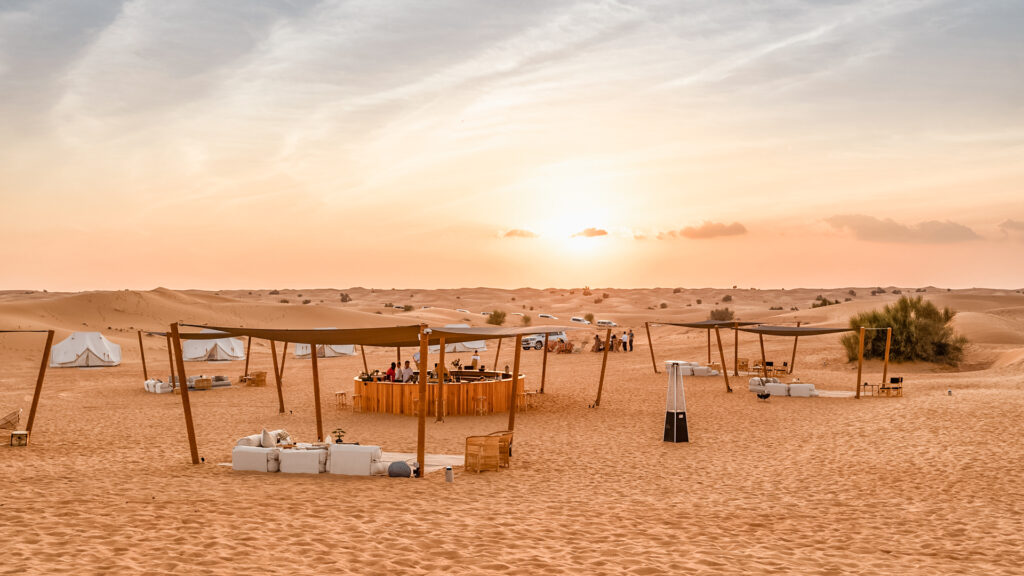
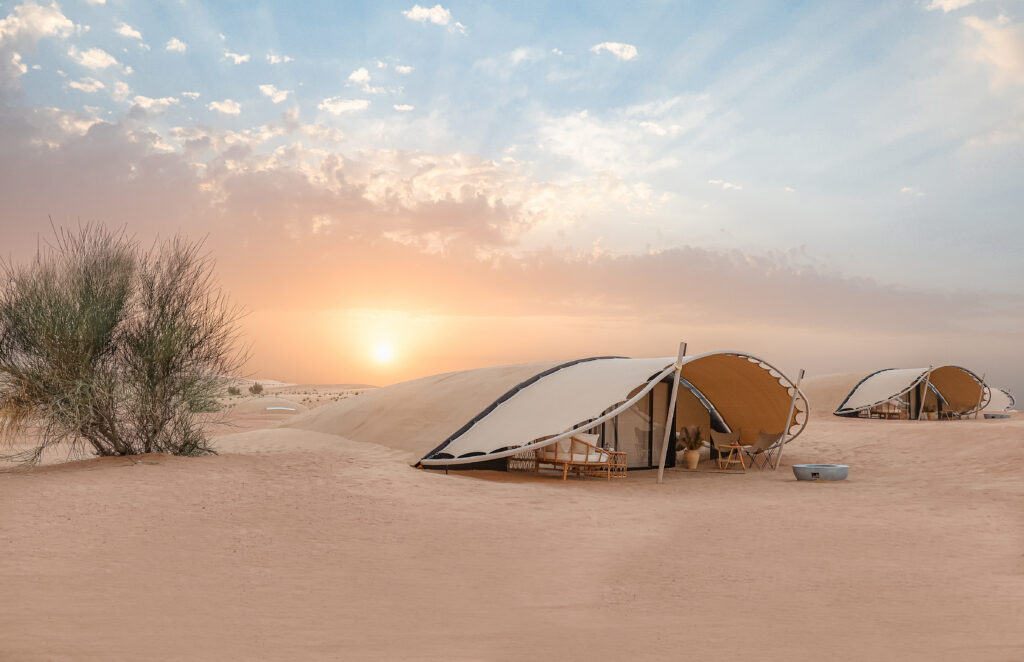
Golden hour sunlight over the desert dunes, the setting for Sonara Camp

The Sea at Night — A Different Kind of Silence

If the desert is about stillness, the sea is about something else: a rhythm. The gentle pitch of the deck beneath your feet, the water slapping the hull in a pattern that is almost regular but never quite predictable, the way the city skyline slides past so slowly you only notice it has moved when you look up from your glass.

Lady Nara is not what most people picture when they hear “yacht dining.” There is no thumping bass, no bottle service, no crowd on the upper deck performing for each other’s Instagram stories. It is a vessel, and it is beautiful, and on a given evening it belongs entirely to you.

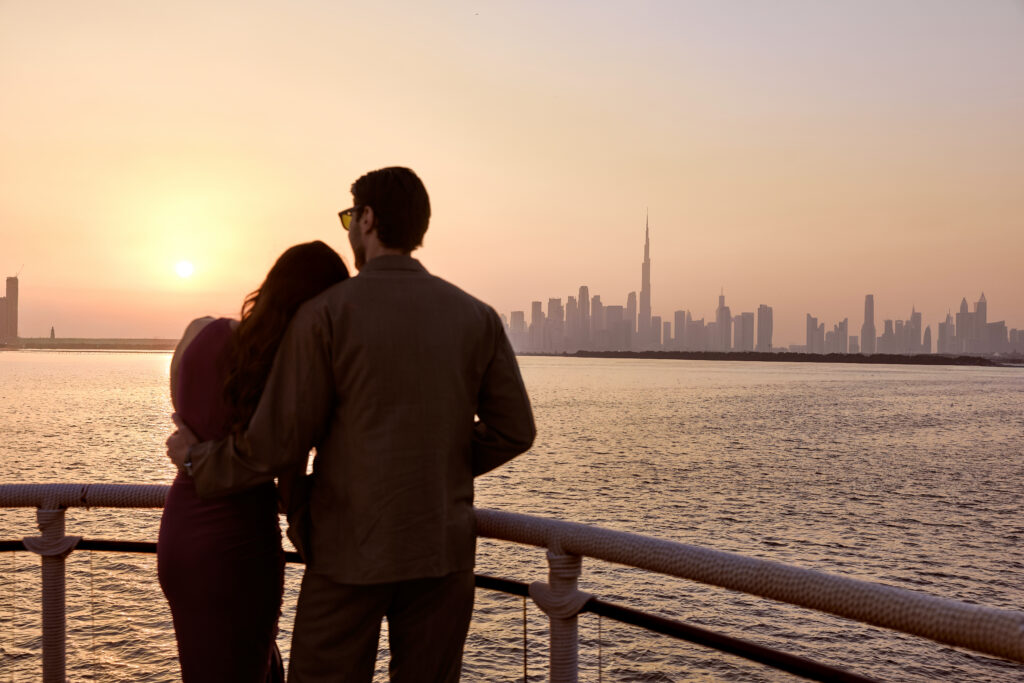
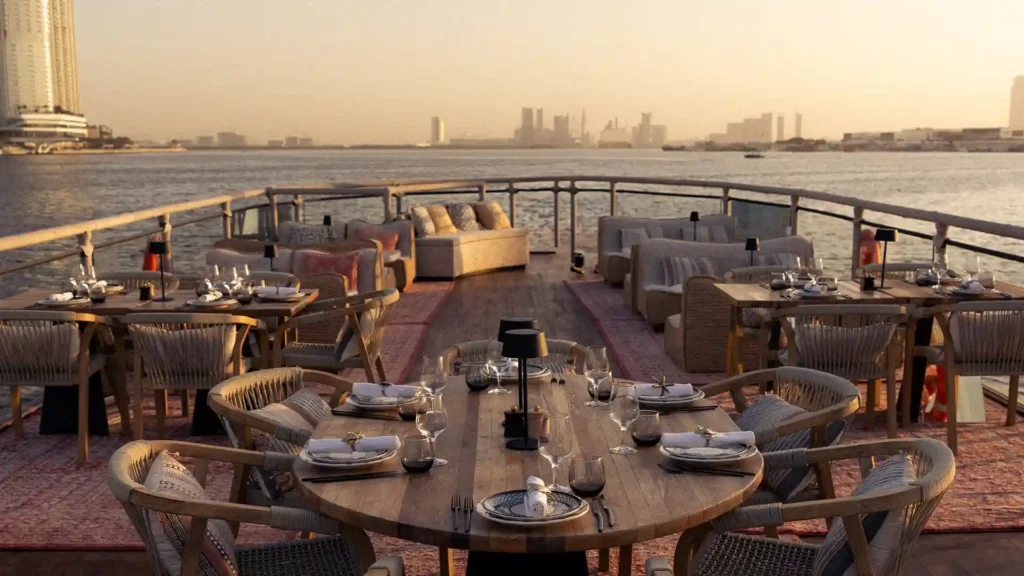
The deck is set for dinner. The lights are low — warm enough to see each other’s faces, dim enough that the skyline behind them matters. The Burj Khalifa is there, and the Marina towers, and the long curve of the JBR coastline, all of it reduced to a strip of light along the horizon. From the water, the city looks like a photograph of itself. It is present but unreachable. You could not get to it quickly if you wanted to, and that distance — that thin skin of dark water between you and everything else — is precisely the point.

Private dining on the water does something to a conversation that a restaurant cannot. The slight movement of the boat requires a different kind of attention. You notice your body more. You hold your glass a little more carefully. You look up from your plate more often, because the view is not fixed — it is drifting, shifting, revealing a new angle of the coastline every few minutes. And because the deck belongs to you, there is no one else’s evening to navigate around. No one squeezing past your table. No one’s chair backing into yours.

The Arabian Gulf at night is not dramatic. It does not crash against rocks or throw spray into the air. It is dark, and warm, and quiet. The water reflects the city in long broken lines of gold and white. The air is salt and diesel and something faintly floral that I have never been able to identify. And the two of you are floating on it, unhurried, uninterrupted, with nowhere to be except exactly where you are.
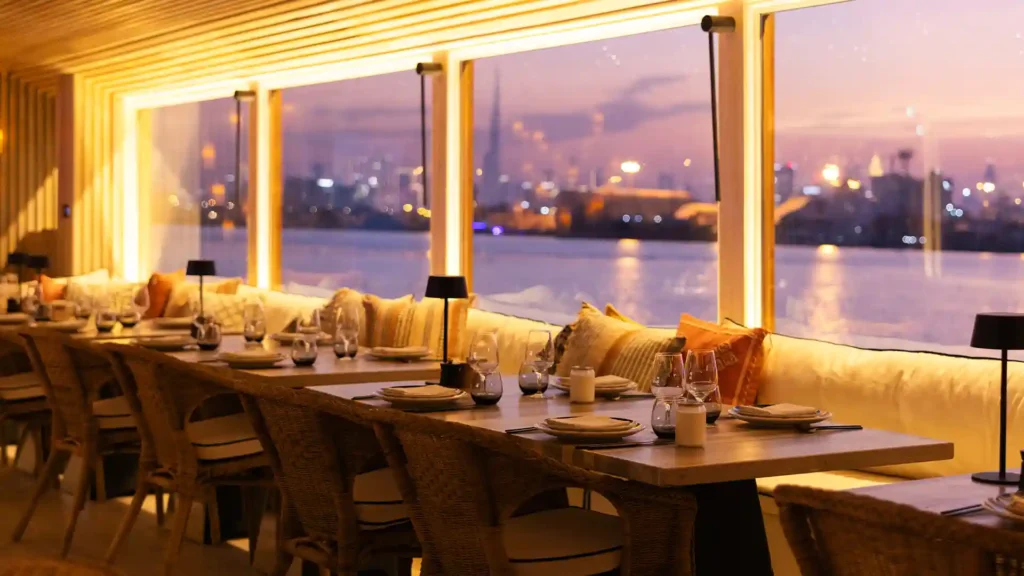
Lady Nara dhow illuminated at night on the Arabian Gulf with Dubai skyline in the background

Some Celebrations Deserve More Than One Night

There are evenings that are complete in themselves — a dinner, a sunset, a drive home with the windows down. And then there are occasions that deserve a longer arc. A proposal. A milestone anniversary. A birthday that closes one decade and opens another. These are not two-hour experiences. They are stories, and stories need a beginning, a middle, and a morning after.

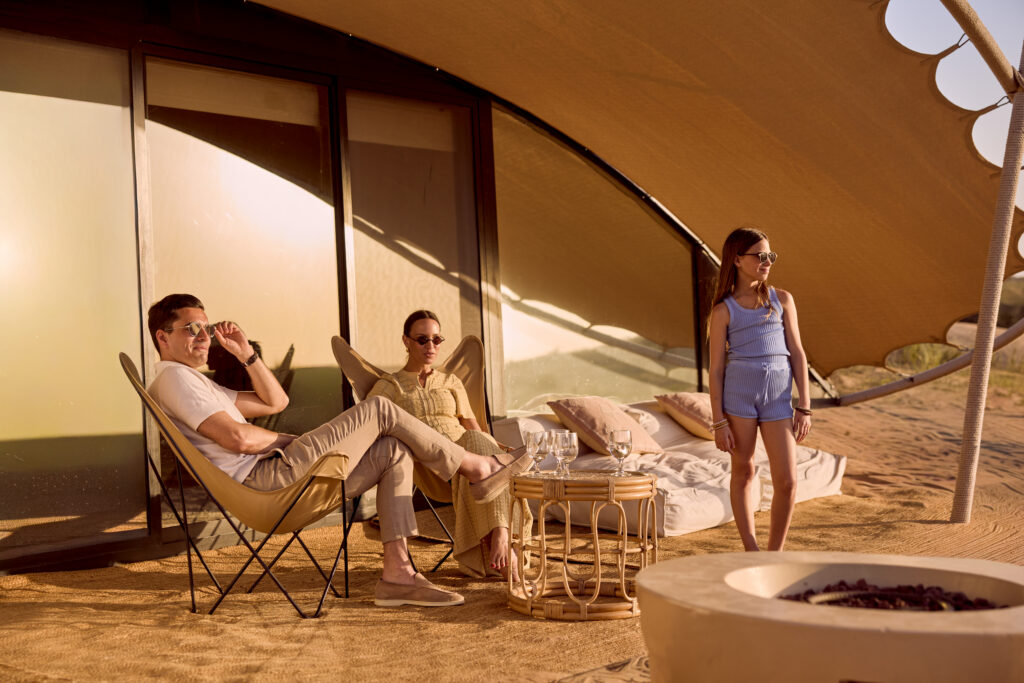
The Nest by Nara exists for those occasions. It is an overnight desert experience — a night under canvas, set deep in the dunes, where dinner is not the destination but the first act.

The evening begins the way any desert evening begins: with the light. You arrive, you settle in, you watch the sun do what it does out here, which is put on a show that would be embarrassing if it were not so sincerely beautiful. Dinner is served. The stars come out. And then, instead of the drive back to the city, instead of the transition from sand to asphalt to elevator to hotel room, you stay.

You stay, and the desert changes around you. The temperature drops. The stars intensify — not slowly, but in waves, as if someone is adjusting the contrast. The silence deepens into something you can almost feel against your skin. And then you sleep, with the desert outside and the canvas above and the sound of absolutely nothing except whatever the two of you are whispering to each other.

Romantic private dining in Dubai usually ends when someone calls the car. At The Nest, it does not end. It transitions. Dinner becomes stargazing. Stargazing becomes sleep. Sleep becomes morning.

And the morning — I need to tell you about the morning. The desert at sunrise is a completely different landscape than the one you saw at sunset. The light comes in flat and pink and impossibly gentle, and the dunes throw long shadows that look like they were drawn there. You sit with coffee in your hand and watch the day arrive, and there is a quality to it that I can only describe as private. The city is waking up somewhere behind you, forty-five minutes and a hundred years away. But here, this morning belongs to you.

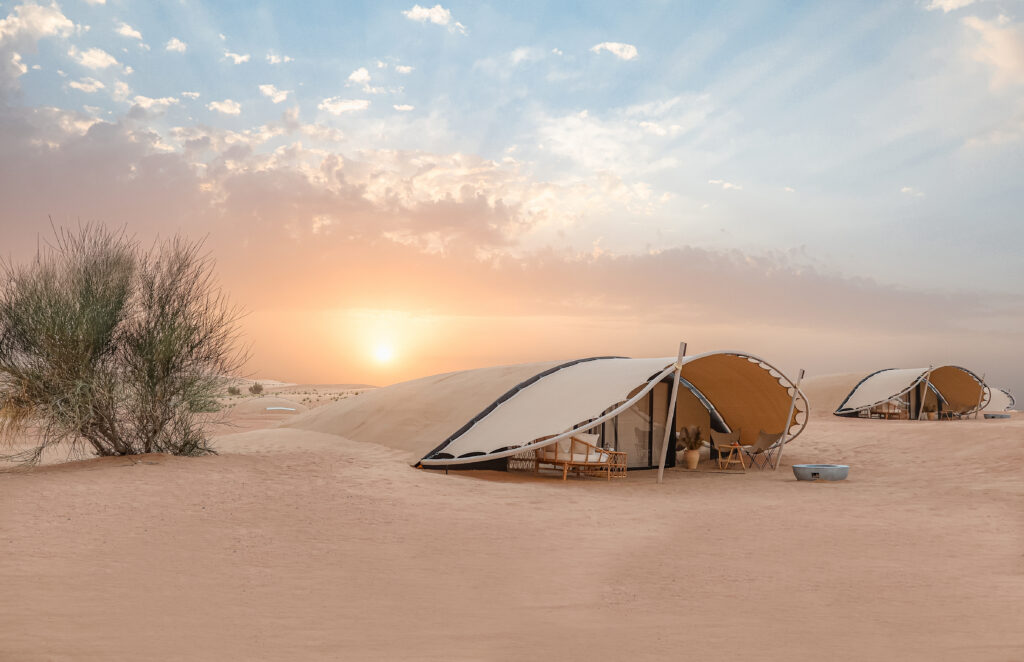
The Nest by Nara overnight desert experience at twilight with warm light glowing from inside
Sunrise over the desert dunes seen from The Nest by Nara overnight experience

The Private Table — Why Intimacy Is the Real Luxury

There is a thread running through the desert and the sea and the overnight experience, and it is not the food, the wine, or the setting — although all three are remarkable. The thread is the absence of other people.

I do not say this to be antisocial. I say it because I have watched enough couples in enough settings to know that the presence of strangers changes everything. In a restaurant, even an excellent one, you are performing your evening in front of an audience. You may not notice them, but your body does. You modulate your voice. You sit a certain way. You are aware, on some level, that your evening is happening alongside thirty other evenings, and that the waiter has a schedule, and that the couple at the next table is having an argument they are trying to keep quiet.

At a private table in the desert, none of this exists. At a private dining setting on the water, none of this exists. Under canvas with the stars overhead, none of this exists. There is just you, the person across from you, and whatever is between you — the good, the complicated, the unspoken, the overdue.

This is not exclusivity as a status symbol. I have no patience for that framing. This is about creating conditions. The conditions for an evening where no one interrupts, no one overhears, no one’s flash goes off at the wrong moment. Where you do not share your evening with anyone except the person you came with.

The luxury is not the linen. It is not the champagne, though the champagne is excellent. The luxury is the silence and your own timing. And the understanding that for the next few hours, nothing in the world requires your attention except the person sitting across the table from you.

Planning a Romantic Evening That Actually Surprises

A few things I have learned, from having helped more people plan these evenings than I can count.

Timing matters more than you think. October through April is the season — the air is cool enough to sit outside for hours without wilting, and the light in those months does something extraordinary at sunset that the summer months simply cannot match. If you can, arrive early enough to watch the full transition from afternoon to evening. The sunset is not a backdrop. It is the opening act.

The details can be arranged — flowers, a specific wine, a particular dessert, live music drifting from a distance. I mention these not as a menu of add-ons but as the kind of touches that turn an evening into a story your partner retells. A song they did not expect. A bottle from the year you met. These things matter because they say: I was paying attention.

Champagne glasses at a private dinner with the Dubai desert sunset in the background

People search for romantic restaurants in Dubai with a view, and I understand the impulse. But the best view is one without a frame around it. A sunset does not need a window. A skyline is more beautiful from the water than from the forty-second floor.

This works for couples at every stage — a first anniversary, a twenty-fifth, a proposal that someone has been planning for months, or a Tuesday night that has no occasion at all except the desire to sit with someone in a beautiful place and say nothing in particular. Some of those Tuesday nights become the most talked-about evenings of a relationship.

The best private romantic dinner for couples is the one that feels like it was designed for exactly two people. Because it was.

What Stays With You

I ask people, afterward, what they remember. I have been doing this for years, informally, the way you ask a friend how their trip was. And the answers have a pattern.

No one leads with the food (even though the food is spectacular). The food is mentioned — usually the second or third thing — and it is mentioned fondly. But it is not what they remember first.

What they remember first is the sky. Every time. The size of it, the depth of it, the way it changed from hour to hour. In the city, you forget the sky exists. There is too much between you and it — buildings, awnings, ceilings, screens. In the desert, or at sea, the sky is the largest thing in the room. It is above you and around you and so close that on certain nights you feel you could reach into it.

They remember the temperature. The way the air cooled as the evening went on, the exact moment they needed the shawl that was already draped across the chair. They remember the quality of the darkness — not the oppressive dark of a windowless room, but the living dark of a desert night, where the stars provide just enough light to see the outline of the dunes and the shape of the person across from you.

They remember the silence. Not the absence of sound, but the absence of everything that was not the two of them.

And then they go quiet for a moment. And I know, from that silence, that they are back there.

Frequently Asked Questions

What is the most romantic dinner experience in Dubai?

The most memorable romantic dinner in Dubai is one where the setting does the work — where there are no walls, no neighboring tables, and nothing between you and the person you came with. Three experiences stand out for different reasons: a desert dinner at Sonara Camp, where the dunes and the sunset become the room; a private evening aboard Lady Nara on the Arabian Gulf, where the city skyline drifts past at a distance; and an overnight stay at The Nest by Nara, where dinner extends into sunrise. Each suits a different kind of celebration, and the right choice depends on whether you want stillness, movement, or a full evening-to-morning arc.

Can you have a private dinner in the Dubai desert?

Yes — and it is one of the most striking ways to spend an evening in this city. At Sonara Camp, a table is set among the dunes with candles, white linen, and a private chef preparing a multi-course dinner while the sun sets and the stars take over. It is a candle light dinner in Dubai in the most literal sense — out here, the candles are the only light source for kilometers. The experience can be extended overnight through The Nest by Nara, where couples stay under canvas through sunrise, turning a dinner into a complete story.

Where can couples have a romantic private dinner in Dubai?

Three settings offer romantic private dining in Dubai, each with a distinct character. The desert — at Sonara Camp, where the silence and the sunset create an intimacy that indoor restaurants cannot replicate. The sea — aboard Lady Nara, where the gentle movement of the water and the distant skyline produce a different kind of quiet. And the overnight desert — at The Nest by Nara, for occasions that deserve more than a few hours. A private romantic dinner for couples works differently in each setting, and the choice comes down to the kind of memory you want to make.

*If you are planning something that matters — a proposal, an anniversary, a night that you want to remember exactly — we would like to help you find the right setting.*
How Sound and Music Shape a Desert Evening in Dubai

One of the things people often assume about the desert is that it is silent.

It isn’t. Well, not really.

Spend enough evenings there and you begin to notice that the desert always has its own sound before anything else is added to it. Wind moving through open space. The sand under your feet. The occasional stillness that somehow feels louder than noise.

That matters more than most people realise.

Because when music is introduced into the desert, it is never moves into the silence. It is moves into an environment that already has its own rhythm.

Across Nara experiences, this understanding shapes the entire evening.

Music is not treated as entertainment layered on top of the experience. It is treated as part of how the night moves. Part of how energy rises, softens, shifts, and settles.

When done well, guests rarely leave remembering a specific song.

What they remember is how the evening felt.

Before the Music, There Is Already Sound

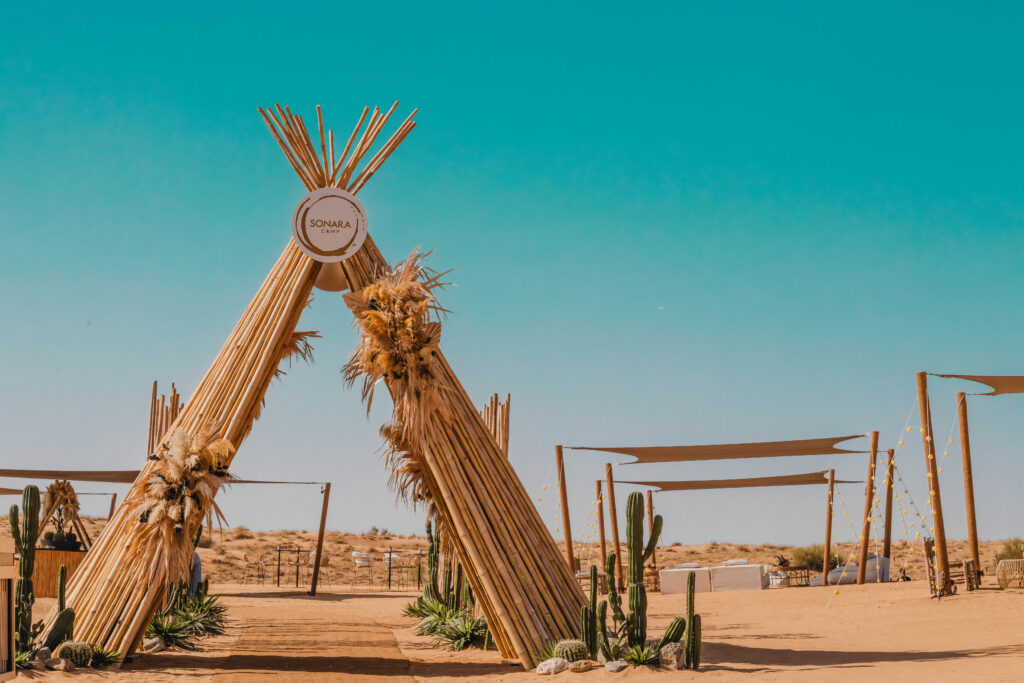
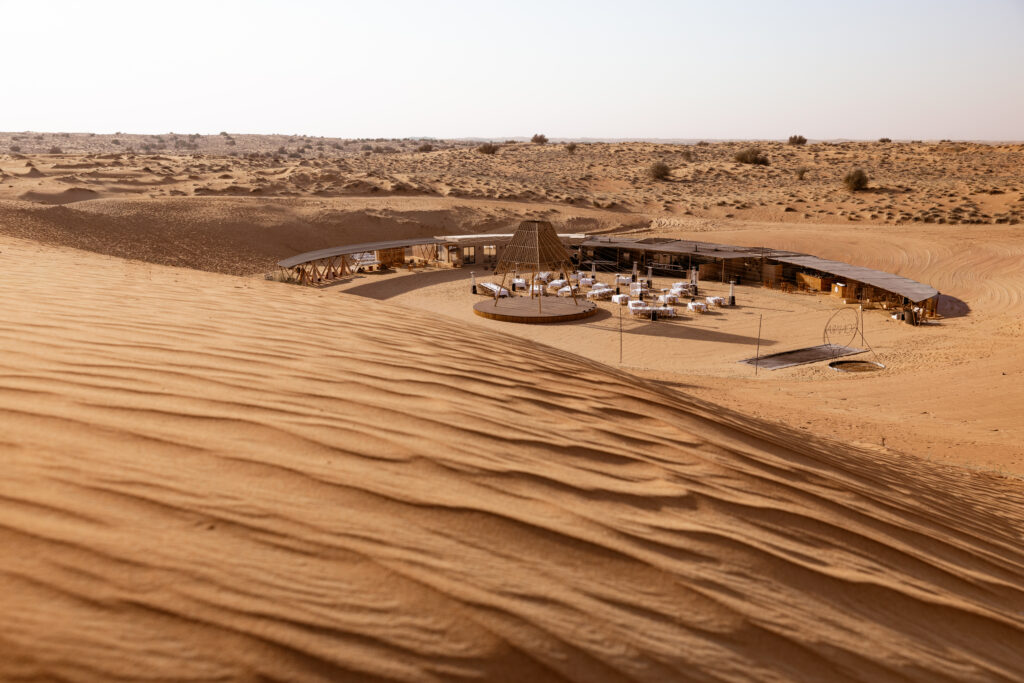
Sonara Camp in the Dubai desert.

What becomes obvious over time is that the desert is never truly quiet.

There is always movement in it.

Wind.
Distance.
The space itself.

Even when nothing is happening, the desert carries presence.

In a city, sound competes with everything around it. In the desert, it sits against something far more open.

Which means even the smallest note feels more deliberate.

It also means restraint matters.

Too much sound too early, and the environment disappears beneath it.

Too little, and the evening risks feeling flat.

The balance is finer than many expect.

Music Should Never Arrive Before the Setting Does

At Sonara Camp, music is present from the beginning, but never in a way that announces itself.

It sits behind the experience at first.

Low enough that conversation still leads.
Subtle enough that guests notice the setting before they notice the soundtrack.

That is intentional.

Arrival should belong to the desert first.

The light. The landscape. The space.

Music enters to support that, not compete with it.

If the soundtrack becomes the first thing guests register, it is usually doing too much.

The Evening Is Built Around Shifts in Energy

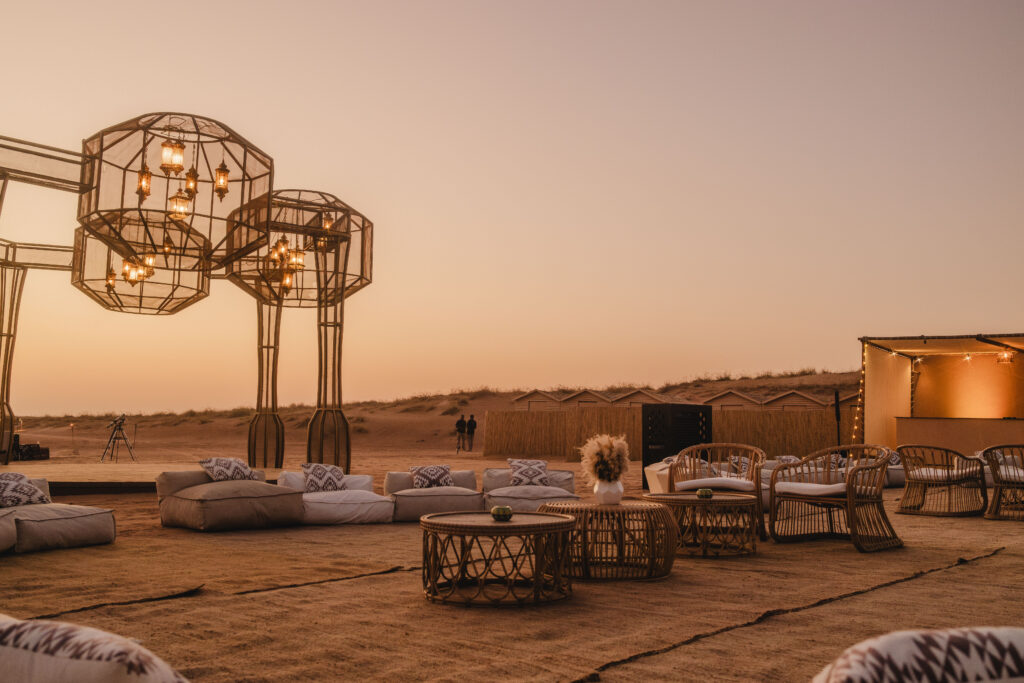
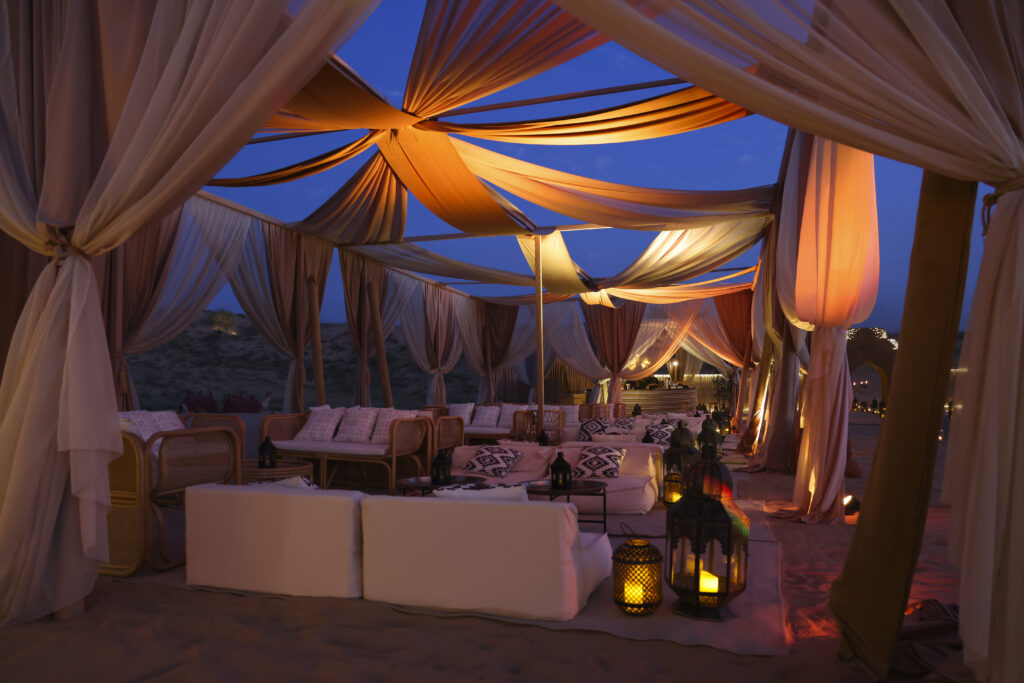
The lounge areas at Nara in the Dubai desert.

A strong desert evening should never feel emotionally flat.

Nor should it remain at one level of intensity throughout.

At Sonara Camp, the soundscape changes with the progression of the night.

Earlier moments remain lighter, more ambient, more spacious.

As dinner settles and the evening deepens, the energy gradually builds.

Not abruptly.

Not theatrically.

Just enough that guests feel the pace changing before they consciously notice why.

That progression is part of what gives the evening momentum.

Without it, even the most beautiful setting risks feeling static, or worse.. flat.

Performance Changes Everything

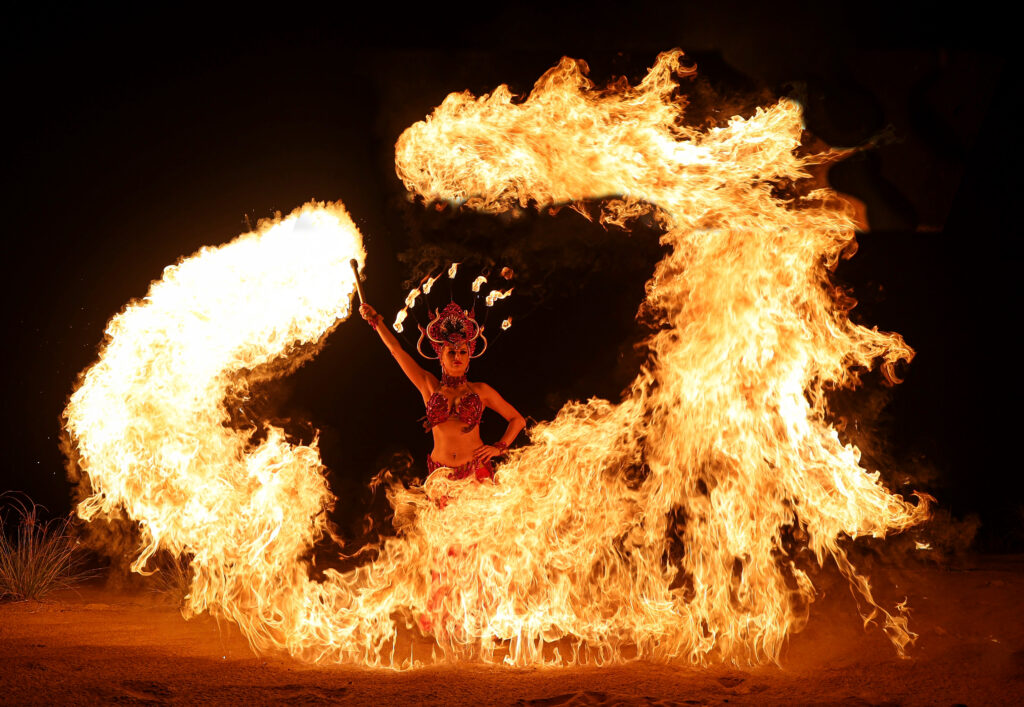
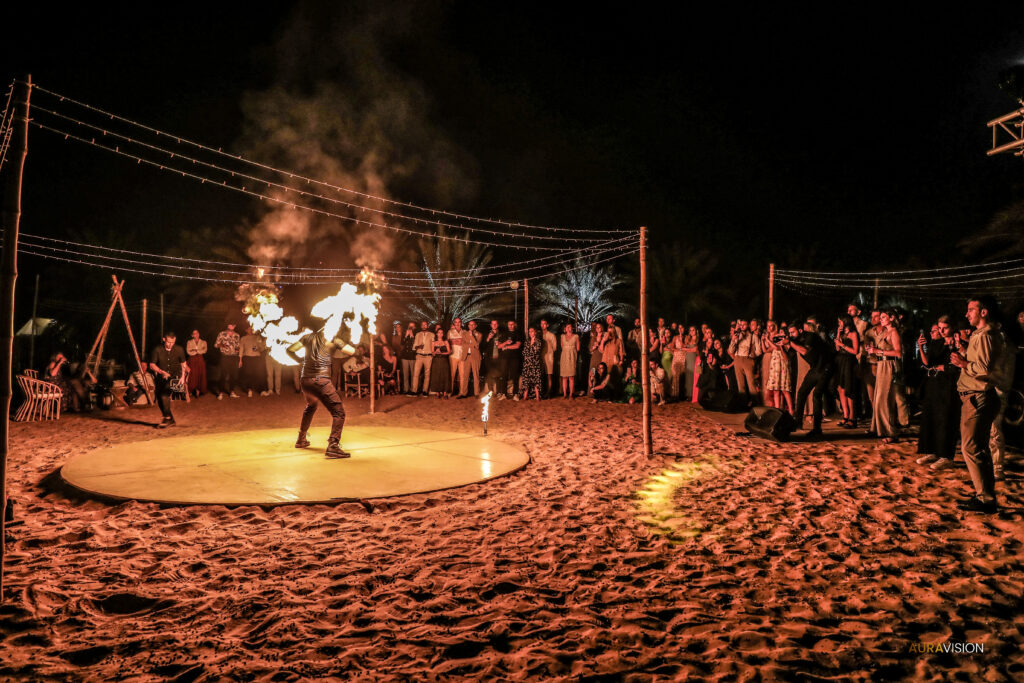
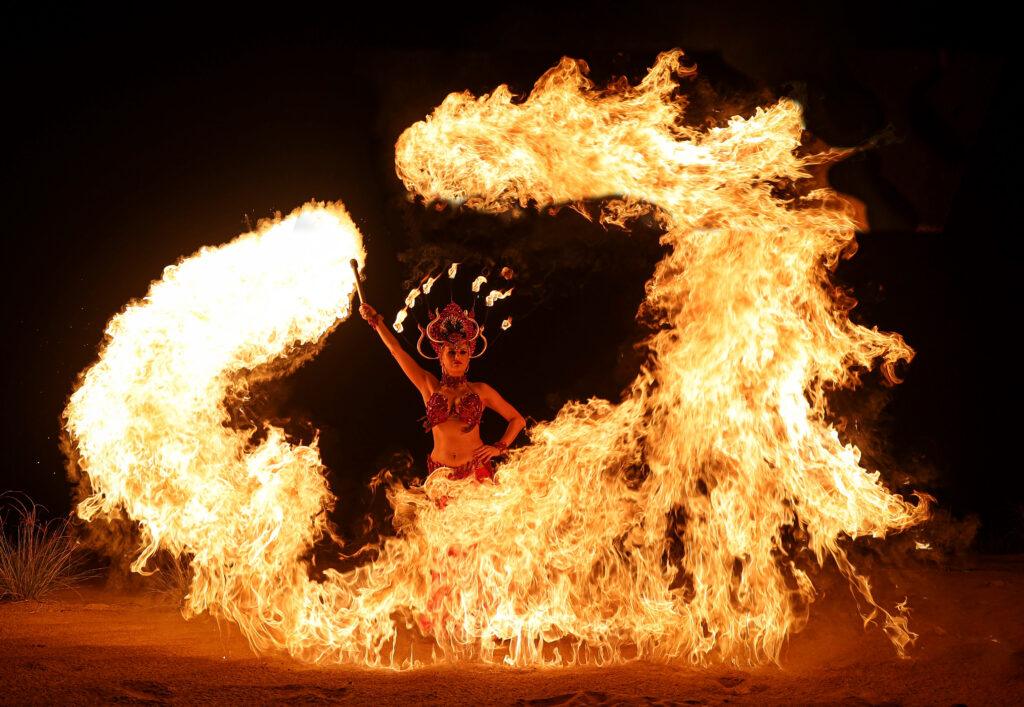
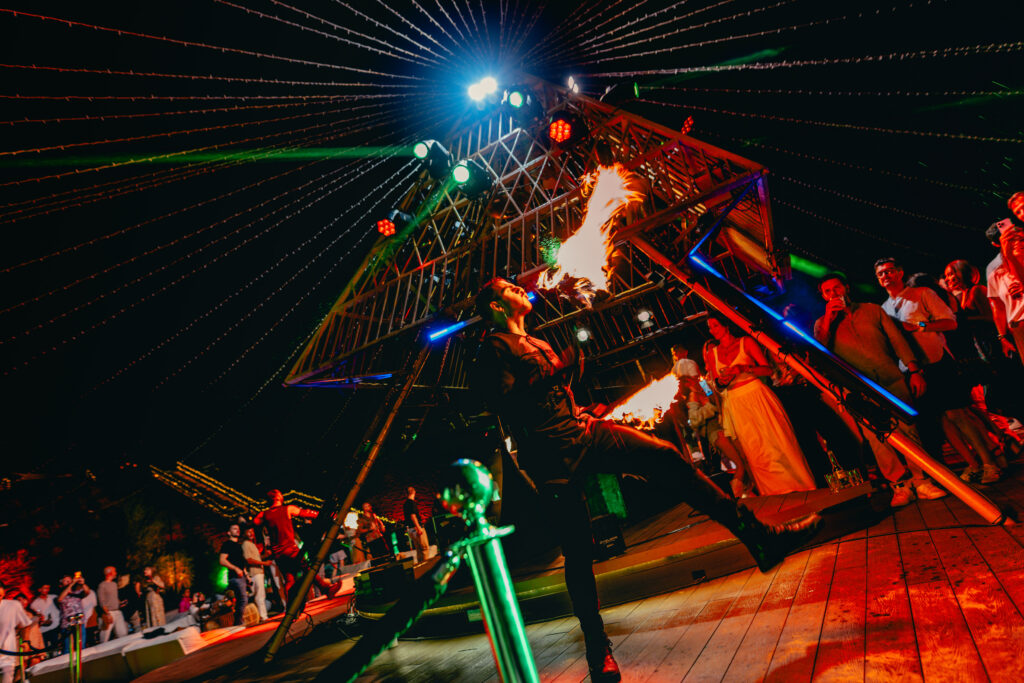
The fire belly dancing show at Sonara Camp Dubai.

There comes a point in the evening when music shifts from atmosphere to centre stage. That moment arrives with performance. Every night.

The soundtrack changes first.

The tempo sharpens. The rhythm becomes more deliberate. The music begins to lead rather than support.

It is this shift in sound, more than anything else, that signals the evening has entered a different phase.

By the time the performance begins, the music is no longer simply part of the background. It is shaping anticipation, directing focus, and controlling the pace of the moment.

At Sonara, the performance soundtrack is selected with that in mind.

Each track is chosen not simply to accompany what guests are watching, but to heighten how the performance is felt.

Because when the right music meets the right moment in the desert, the atmosphere changes instantly.

In the Desert, Sound Has to Be Designed Differently

The Charcoal Cage show at Sonara Camp in the Dubai desert.

Open desert changes how sound behaves.

There are no walls to contain it.
No ceilings to soften it.
No architecture to shape it.

Everything carries differently.

Which means sound in the desert cannot be approached the way it would be indoors.

At Nara, music, performance, and sound levels are adjusted constantly depending on weather, wind, spacing, and where guests are within the environment.

Because what works in one moment may feel entirely wrong ten minutes later.

When guests say an evening felt seamless, this is often part of what they are responding to without realising it.

The Night Should Know How to Come Back Down

A woman looking at the performance on stage at Sonara Camp Dubai.

One of the most overlooked parts of pacing is what happens after the peak.

Too many experiences build toward a climax and then end abruptly.

The stronger approach is to let the evening descend gradually.

Once a performance ends, the energy softens again.

Music lowers. Conversation returns. Guests settle back into the space.

The night continues, but differently than before.

That comedown matters.

Without it, the evening feels cut short.

With it, the entire experience feels more complete.

What Guests Remember Is Rarely the Music Itself

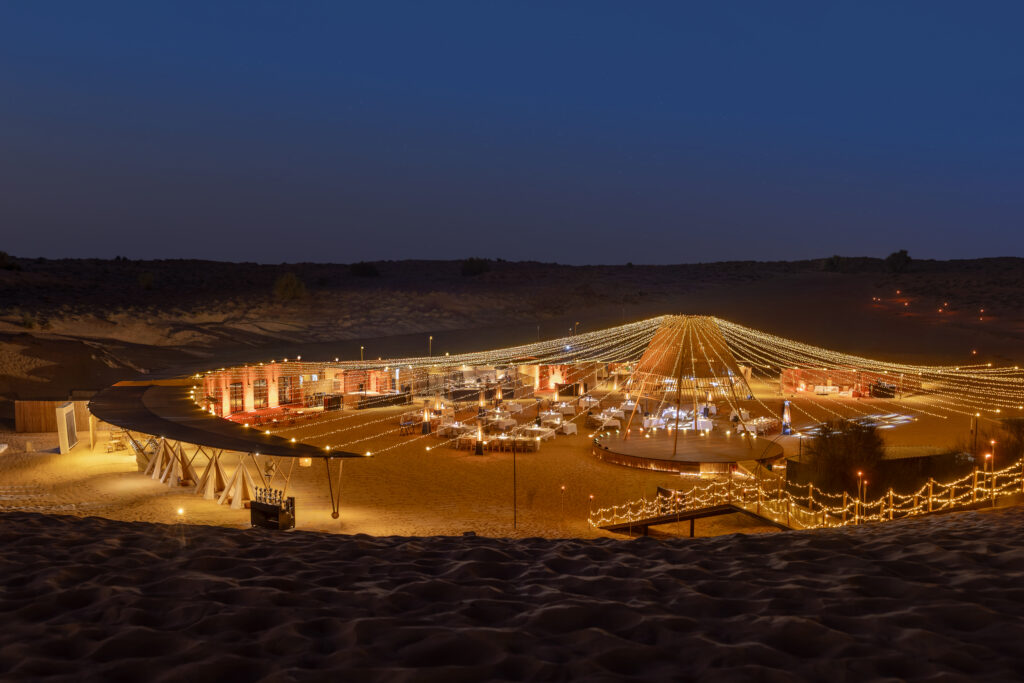
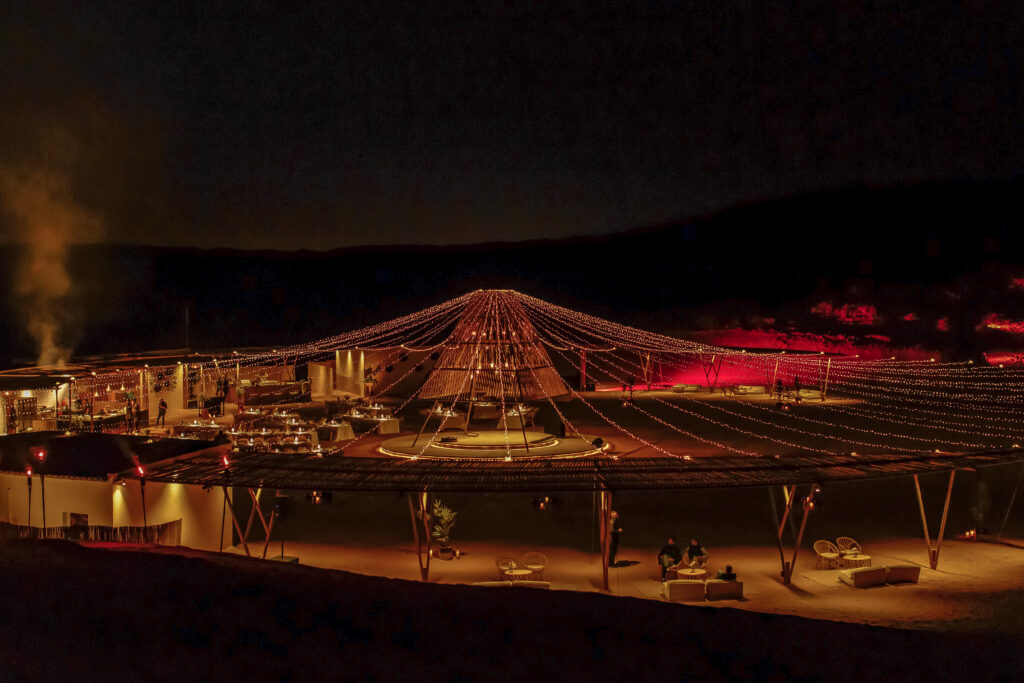
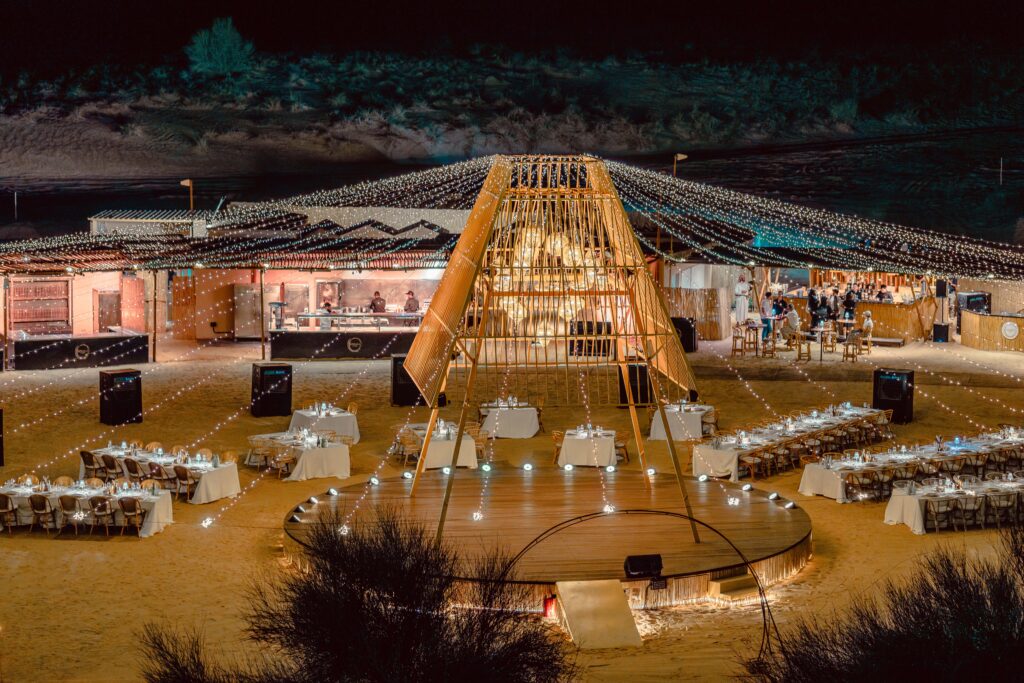
Sonara Camp at night, nestled inside the Dubai Desert Conversation Reserve.

Very few guests leave talking about specific songs.

They talk about the atmosphere.

The feeling when the performance began.
The way the energy shifted.
The moment the fire started.
The sense that the night kept changing without ever feeling forced.

That is the role music should play in an experience like this.

Not to dominate. Not to announce itself. Simply to help shape the way the evening moves.

At its best, music disappears into memory not because it was unnoticed, but because it was felt rather than observed.

Frequently Asked Questions

What kind of music is played during a desert dinner experience in Dubai?

Music typically shifts throughout the evening. Earlier moments tend to feature more ambient, understated sound, while later stages may introduce more immersive music tied to performance or energy shifts within the night.

Is the music live during desert experiences like Sonara?

Music and performance elements are introduced during key moments of the evening at Sonara Camp, with sound used to support the wider progression of the experience. Depending on the moment, this may include live performance, curated soundtrack, or a combination of both.

Do desert camps in Dubai play traditional or Arabic music?

Some experiences incorporate traditional or regional influences, while others take a more contemporary approach depending on the concept and atmosphere being created.

Is the desert dinner experience loud or more relaxed?

It moves between both. Earlier parts of the evening tend to remain more relaxed, while performance-led moments introduce greater energy and intensity before the atmosphere softens again.

Does music define the desert experience?

Not on its own. The strongest desert experiences are shaped by a combination of setting, pace, atmosphere, and sound. Music enhances the experience, but should never overpower the environment itself.

Where to Host a Private Group Dinner in Dubai: Desert, Sea, or City

Planning a private group dinner in Dubai involves more than choosing a menu and confirming a guest count.

The setting, the pace of the evening, the way guests move through the experience, and the level of privacy all shape how the night is ultimately remembered.

A dinner for twenty in the desert carries a very different energy from a dinner for twenty on the water. A corporate gathering in a private residence requires a different rhythm than a celebratory dinner in a city venue.

The strongest private dining Dubai experiences are planned around those distinctions from the outset.

For hosts organising a private group dinner Dubai, this guide outlines the key decisions that shape the evening, and how to choose the format that best suits the occasion.

Start with the Setting: Desert, Sea, or City

The setting determines the tone of the evening before guests arrive.

A desert setting creates distance from the city and naturally slows the pace of the event. It suits occasions where atmosphere, immersion, and a sense of removal are part of the appeal.

Dining on the water introduces movement and fluidity. The setting feels more dynamic, with the pace shaped partly by the environment itself.

City and private residence settings offer greater immediacy and convenience, often creating a more contained and logistically straightforward experience.

Some providers operate within only one environment.

Others, such as Nara’s private events, plan experiences across desert, sea, city venues, and private homes, allowing the setting to be chosen based on the occasion rather than the operator’s limitations.

Define the Size and Shape of the Group

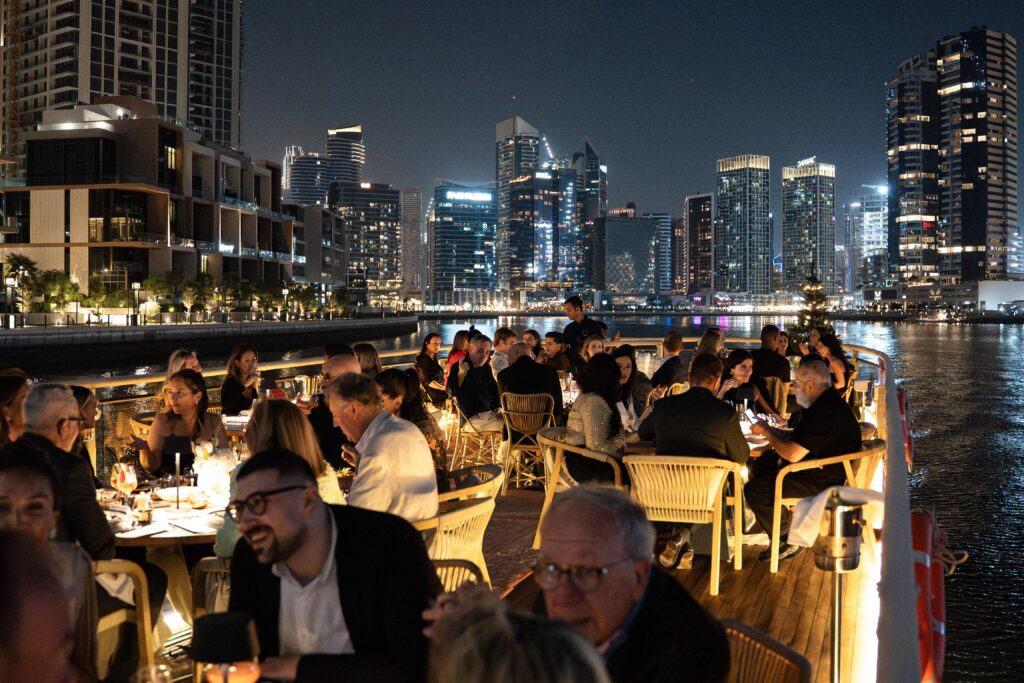
A bustling dinner aboard Lady Nara in Dubai.

Group size affects more than capacity.

It influences layout, service style, energy, and how the evening unfolds.

Smaller groups allow for greater flexibility in setup and pacing. Guests can move more naturally, conversation feels more fluid, and the experience can remain less structured.

Larger groups often require clearer planning around layout, timing, and guest flow to ensure the evening feels cohesive rather than fragmented.

The shape of the group matters too.

A seated long-table dinner creates a different dynamic from multiple smaller tables or lounge-style arrangements.

These choices affect interaction as much as aesthetics.

Decide on the Level of Privacy

A crowd watching the fire show at Nara Oasis in Dubai.

Not every occasion requires full exclusivity.

Some dinners benefit from the energy of a wider atmosphere while still feeling contained.

Others require complete privacy, with no surrounding guests and full control over the environment.

Choosing the right level of privacy influences:

  • The pace of the evening
  • The degree of customisation possible
  • Guest interaction
  • Overall atmosphere

The most effective private dining experiences begin by understanding whether privacy is essential to the event itself, or simply preferred.

The Flow of the Evening

A strong group dinner is rarely remembered only for the meal.

It is remembered for how the evening moved. Most private dinners naturally follow phases:

Arrival
Dining
Post-dinner conversation or continuation

Some settings allow those phases to happen across multiple spaces.

Guests may arrive in one setting, dine in another, and continue elsewhere afterward.

Other venues remain fixed in one location throughout.

Neither is inherently better.

The decision depends on whether the host wants the evening to feel structured, fluid, social, or more contained.

When One Team Handles Everything

An intimate private concert in the Dubai Desert, with Nara Desert Experiences.

Private group dinners often involve more moving parts than expected.

Venue.
Catering.
Furniture.
Service staff.
Transport.
Lighting & Sound.
Timing.
Guest management.

When handled across multiple vendors, even simple events can become operationally fragmented.

Some hosts prefer to work with one team capable of managing the experience end-to-end.

Providers such as Nara Private Events oversee everything from concept and catering to setup, logistics, staffing, and execution, creating a more seamless planning process across desert, sea, city venues, and private homes.

For hosts, this often means less coordination and a significantly smoother result.

Align the Setting with the Occasion

A fire belly dancer at Nara Dubai's Signature Fire Show.

The right setting depends heavily on why the dinner is being held.

Corporate dinners often benefit from clearer structure, smoother logistics, and environments that support conversation and hosting.

Celebratory social dinners may allow for more flexibility, atmosphere, and experiential layering.

Client entertainment may call for polish and discretion.

Family occasions may prioritise comfort and pacing.

The setting should support the purpose of the evening rather than simply impress visually.

Consider What Happens Beyond the Table

Some dinners end when the meal ends.

Others are designed to continue.

This matters more than many hosts expect.

When guests have somewhere to move afterward, the evening tends to feel more layered and less transactional.

A fire lounge.
A post-dinner deck on the water.
A private cinema.
A second social space within the venue.

Settings that allow the evening to extend beyond the table often create stronger memories because the experience is not compressed into one seated moment.

Practical Details That Shape the Experience

The Sonara Camp in Dubai at night.

Many of the details guests remember are shaped by decisions they never see.

Arrival timing.
Transport coordination.
Weather contingencies.
Guest comfort.
Pacing between moments.
Transitions between spaces.

The best private event dinner Dubai experiences feel effortless precisely because these details have been planned carefully in advance.

Operational ease often matters more to the guest experience than any decorative element

Choosing the Right Private Dining Experience in Dubai

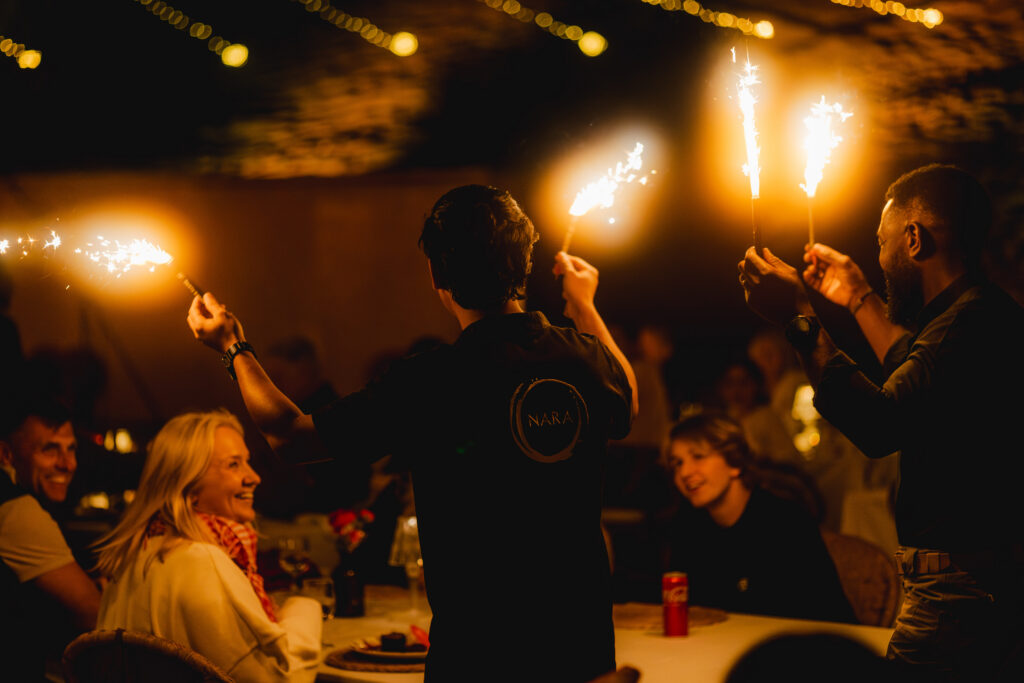
A family celebrating a birthday at Sonara Camp in Dubai.

The right private dining format depends on balancing three core considerations:

  • Setting
  • Group size
  • Level of privacy

But above all, the strongest decisions are made by prioritising how the evening is meant to feel.

More immersive or more convenient.
More social or more contained.
More structured or more fluid.

For hosts planning a corporate dinner Dubai, group dinner Dubai, or fully bespoke private event, the most successful experiences begin with that emotional intention, then build the logistics around it.

For more tailored occasions, Nara Private Events can help shape the evening across desert, sea, city, or private residence settings, designing each dinner around the host’s vision and the needs of the group.

Frequently Asked Questions

What is private dining in Dubai?

Private dining refers to curated dining experiences hosted in exclusive or semi-exclusive settings, ranging from private venues and residences to desert, sea, and bespoke event environments.

How do you organise a group dinner in Dubai?

Planning begins with choosing the right setting, group size, and level of privacy, followed by coordinating logistics such as catering, layout, guest flow, and operational timing.

Are private dining experiences available in the desert?

Yes. Private desert dining is widely available in Dubai, ranging from intimate dinners for small groups to larger hosted celebrations and bespoke events. For guests seeking a more tailored approach, Nara Private Events designs private desert dining experiences around the occasion itself, managing everything from concept, catering, and setup to service, atmosphere, and on-site execution.

Can you host corporate dinners in the Dubai desert or on a yacht?

Yes. Both desert and sea settings can be adapted for corporate dinners depending on the tone and structure required for the event.

Can private group dinners be arranged in a private home in Dubai?

Yes. Some private events teams, including Nara Private Events, can design and deliver full dining experiences within private residences, managing setup, catering, staffing, and operations.

What is the ideal group size for a private dinner?

There is no fixed ideal size. The best format depends on the setting, desired atmosphere, and how the host wants guests to interact.

How far in advance should you plan a private group dinner in Dubai?

For more bespoke or logistically complex events, several weeks’ notice is ideal, particularly during peak season or for larger groups.

Where to Plan a Unique Birthday Celebration in Dubai’s Desert

Some birthdays call for more than another dinner reservation.

Not necessarily something larger. Just something that feels more considered. More removed from the expected. More memorable for reasons beyond decoration or scale.

The Dubai desert offers exactly that.

Distance from the city changes the tone of a celebration before the evening has even begun. The pace slows. The setting opens. What might feel familiar elsewhere takes on a different kind of significance when placed against open dunes and uninterrupted sky.

For those looking beyond conventional venues, a birthday celebration Dubai can feel entirely different in the desert.

These are the formats and settings that make desert birthdays some of the most memorable celebrations in the city.

Why the Desert Changes the Way You Celebrate

The desert alters expectations immediately.

Simply leaving the city behind creates a sense that the evening matters more.

The setting does part of the work on its own.

There is less pressure to manufacture atmosphere when the environment already feels distinct from everyday life.

Celebrations in the desert also tend to feel less performative.

Guests are not moving between venues or other large groups of people.
There is no surrounding city noise.
No pressure for the evening to keep pace with what is happening elsewhere.

The environment slows everything down.

And that slower pace often makes the celebration feel more personal as a result.

A Dinner That Feels Private, Even in a Shared Setting

Sonara Camp in Dubai at night.

Not every memorable desert birthday requires full exclusivity.

In well-designed settings, even shared-format experiences can feel remarkably contained.

Spacing matters.
Layout matters.
The way the environment directs attention matters.

When tables are positioned thoughtfully and guest flow is managed well, the wider atmosphere fades into the background.

The focus remains where it should. Within the group itself.

Experiences such as Sonara Camp demonstrate how a birthday dinner Dubai desert can feel intimate even without becoming fully private, offering enough space and atmosphere for the celebration to remain self-contained.

A Fully Private Birthday Dinner in the Desert

For guests seeking complete privacy, dedicated private desert setups create an entirely different dynamic.

The evening becomes shaped around the group rather than around a shared programme.

There is no surrounding activity.
No neighbouring tables.
No pressure to align with anyone else’s pace.

The group sets the rhythm.

Dinner can stretch longer.
Toasts can happen naturally.
Conversation remains uninterrupted.

For milestone birthdays or celebrations where privacy matters, a private birthday celebration Dubai in the desert offers a level of exclusivity that few city venues can replicate.

A Birthday That Extends Beyond the Table

The signature fire show at Sonara Camp during dinner time.

The strongest desert celebrations rarely stay centred around the table for the entire evening.

Part of what makes the setting memorable is the ability to move through different moments as the night unfolds.

Guests rise from dinner.
Gather closer to the fire.
Step into the energy of live performances.
Shift naturally between dining, conversation, and the wider atmosphere around them.

In more layered desert experiences, the celebration becomes more than a seated meal. It evolves through the evening, allowing guests to engage with multiple facets of the night rather than remaining in one place throughout.

A Celebration That Builds Around the Sunset

Sonara Camp at sunset.

Sunset changes the pace of a desert celebration without needing much help.

Guests arrive while the sunlight is still bright, and over the course of the evening the entire setting shifts around them.

The heat subsides.
The dunes soften in colour.
The sky gradually darkens.

It gives the celebration a natural sense of progression.

Many of the most memorable desert birthday experiences are timed around sunset for exactly that reason. The setting does much of the work on its own, allowing the evening to build naturally without needing to force the moment.

Smaller Gatherings That Feel More Considered

The desert particularly suits smaller groups.

Celebrations with fewer guests often feel more impactful there than they would in traditional venues.

Without the pressure of filling a large room or matching the energy of a busy venue, smaller groups become the advantage rather than the compromise.

Conversation flows more naturally.
The pace remains flexible.
The experience adapts around the group rather than the reverse.

For intimate celebrations, this often creates a more memorable luxury birthday Dubai experience than scale alone ever could.

Celebrations That Feel Different Each Time

Nara Desert Escape setup at sunset in Dubai.

One of the advantages of celebrating in the desert is that no two evenings feel entirely the same.

The light shifts differently.
The weather changes.
The setup evolves.
The pace of the group alters the atmosphere.

Even for returning guests, the environment prevents the experience from feeling repeated.

This makes the desert particularly compelling for those who mark birthdays with intention each year and want the occasion to feel distinct every time.

The celebration is remembered less for what was included and more for how it felt.

Choosing the Right Desert Birthday Experience

A birthday celebration at Sonara Camp in Dubai.

The right desert birthday experience depends less on the menu and more on the kind of evening being planned.

Consider:

  • Group size
    Smaller gatherings often benefit from more intimate setups, while larger groups may suit broader hosted formats.
  • Level of privacy
    Some celebrations work best in a shared atmosphere. Others require full exclusivity.
  • Desired pace
    A quicker celebratory dinner creates a different tone from an extended evening or overnight stay.
  • Atmosphere
    Some groups want energy. Others want stillness. The desert can accommodate both, depending on format.

Choosing well means selecting the version of the desert that best matches how the celebration is meant to feel. For guests seeking something more tailored, Nara Private Events can help shape bespoke desert celebrations around the occasion itself, guiding everything from atmosphere and pacing to setup and flow in order to create a birthday experience that feels entirely personal to the host.

Frequently Asked Questions

Can you celebrate a birthday in the Dubai desert?

Yes. The Dubai desert has become one of the city’s most distinctive settings for birthdays, with celebration formats ranging from shared sunset dinners to fully private setups and overnight stays. Experiences by Nara span each of these formats, allowing guests to choose between lively shared evenings at Sonara Camp, more intimate private dining setups, or extended overnight celebrations at The Nest.

What is included in a desert birthday dinner in Dubai?

Inclusions vary by format and operator, but most desert birthday dinners include dining, hospitality, and access to the wider evening setting. More curated experiences may also include fire lounges, entertainment, or extended post-dinner activities.

Are private birthday celebrations available in the desert?

Yes. Private desert birthday celebrations can be arranged in dedicated setups away from shared guest areas, allowing the evening to be tailored entirely around the group. Through Nara Private Events, celebrations can be shaped from the ground up, with the team working closely with guests to bring bespoke birthday concepts to life, from intimate private dinners to fully customised desert celebrations designed around the occasion.

Is the desert suitable for group birthday celebrations?

Yes. The desert works particularly well for group celebrations, with formats available for both intimate gatherings and larger hosted occasions.

Can you personalise a birthday experience in the desert?

Many operators offer varying levels of customisation, from private setups and bespoke styling to tailored pacing and added experience elements. For guests seeking a more personalised approach, Nara Private Events works closely with hosts to shape desert celebrations around the occasion itself, creating bespoke experiences designed to reflect the atmosphere, scale, and vision of the event.

What is the best time of year for a desert birthday celebration?

The cooler months in Dubai, typically from October through April, are considered ideal for desert celebrations due to the more comfortable evening temperatures.

Alternative Dubai Desert Experiences Beyond the Standard Safari

For many visitors, a desert safari is treated as the default way to experience the Dubai desert.

A few hours of dune driving, dinner in a shared camp, a short programme of entertainment, then the return to the city.

For first-time visitors, it often serves its purpose.

But for those who spend more time in Dubai, or who return looking for something more considered, it quickly becomes clear that the desert offers far more than the standard safari format suggests.

Some of the most memorable things to do Dubai desert involve less activity, less structure, and less emphasis on spectacle.

They prioritise atmosphere over itinerary. Privacy over volume. Time in the landscape over movement through it.

For guests looking beyond the expected, these are the unique desert experiences Dubai offers that many tourists never realise exist.

Why Most Desert Experiences Feel the Same

A group of friends camel riding in the Dubai desert.

Many desert experiences in Dubai follow a similar format; guests are collected at a fixed time, activities follow a fixed sequence, the evening moves according to a visible schedule.

Included in the standard formats are a dune drive, sunset stop, buffet-style dinner, and live entertainment.

The structure is efficient, but predictable.

In many cases, the focus sits on activity rather than atmosphere, with guests moved through the desert rather than given time to settle into it.

For those looking for a more memorable luxury desert experience Dubai, what often matters most is not adding more to the itinerary.

It is removing what makes the experience feel standardised in the first place.

1. Dinner That Moves With the Evening

Sonara Camp in Dubai at night.

In more considered desert experiences, dinner is not treated as a single fixed event.

It becomes part of the evening’s progression.

Guests may begin with sunset drinks in one setting, dine in another, and continue the night elsewhere once the meal has ended.

Rather than centring around one table, the evening shifts naturally through different settings as it progresses. It is this shift that changes the rhythm of the evening entirely.

Instead of dinner functioning as a scheduled stop within the itinerary, it becomes part of a night that develops gradually.

Experiences such as Sonara Camp have helped redefine this approach, building the evening around movement, atmosphere, and pacing rather than simply service.

2. Desert Evenings Designed Around Stillness

Some of the most distinctive Dubai desert activities involve doing less, not more.

Reduced guest numbers.
Greater spacing.
Minimal entertainment.
Fewer interruptions.

In these environments, the desert itself becomes the focal point.

Guests notice the silence.
The scale.
The way the landscape changes once the light begins to fall.

Experiences designed around stillness tend to leave a stronger impression precisely because they allow the environment to do more of the work.

Rather than competing with the desert, they let it shape the evening.

3. Private Setups Away from Shared Camps

A proposal at Nara private desert experiences in Dubai.

For guests seeking privacy, some of the most compelling alternatives to standard safari formats are fully private desert setups.

These experiences move away from communal camps entirely.

Instead of joining a shared environment, guests are hosted in dedicated private settings positioned away from larger groups.

The difference is immediate.

The pace becomes more flexible.
Conversation feels more natural.
The evening becomes shaped around the group rather than the other way around.

For celebrations, proposals, or simply guests seeking a more personal private desert experience Dubai, this often changes the experience more than any individual activity could.

4. Staying Overnight in the Desert

The Nest, a Luxury eco-sanctuary retreat in Dubai, at sunrise.

Most desert experiences end just as the landscape becomes most interesting.

Once the temperature drops.
Once the sky clears.
Once the desert becomes quiet.

Staying overnight changes that completely.

An overnight desert Dubai experience allows guests to remain once the evening crowds have left and the landscape shifts into something quieter and more expansive.

The desert at night feels entirely different from the desert at sunset.

And the desert at sunrise changes again.

Experiences such as The Nest by Nara extend the desert beyond a single evening, allowing guests to experience its full rhythm rather than only its most touristic hours.

5. Evenings That Continue Beyond Dinner

Stargazing in the Dubai desert, at The Nest by Nara.

Some of the most memorable desert evenings are the ones that do not end when dinner does.

In more layered experiences, the night continues naturally into quieter moments.

Guests remain around the fire.
Move into stargazing sessions.
Watch films beneath the open sky.
Or simply stay where they are as the evening slows further.

The absence of a hard finish changes the atmosphere entirely.

Without the usual cue that the experience is over, guests tend to settle deeper into the setting.

This is where many alternative desert experiences Dubai distinguish themselves most clearly from safari-style formats.

6. Desert Experiences Designed for Small Groups

Group size shapes the experience more than most guests expect.

Larger camps create energy, but they also create noise, waiting, and reduced flexibility.

Smaller-format experiences allow for greater responsiveness.

Service feels more personal.
Pacing becomes less rigid.
The evening adapts more easily to the group.

For guests who value atmosphere and attention to detail, this often matters more than the activity list itself.

7. Occasions That Feel Different in the Desert

A birthday celebration at Sonara Camp in Dubai.

Certain occasions feel markedly different when removed from conventional venues.

The scale of the desert changes perception.

Celebrations feel less staged.
Private moments feel more significant.
Even simple dinners carry greater weight when placed against open landscape and distance from the city.

This is part of why the desert has become an increasingly sought-after setting for proposals, milestone birthdays, anniversaries, and private hosting.

The environment alters the tone of the occasion before anything else has been added.

What to Look for When Choosing a Desert Experience

Not all desert experiences differ because of the activities included.

Often, the real distinction lies elsewhere.

In the number of guests.
In the spacing between tables.
In whether the evening is fixed or flexible.
In whether the atmosphere is built around volume or intention.

When comparing things to do Dubai desert, guests should look beyond the itinerary itself and consider:

  • Group size
  • Level of privacy
  • Pace of the evening
  • How structured the experience feels
  • Whether the environment allows the desert itself to remain central

Because in the desert, how the experience is designed often matters more than what is technically included.

Frequently Asked Questions

What are the best desert experiences in Dubai besides safari?

Beyond standard safari formats, some of the most memorable desert experiences include private dining, low-density evening camps, overnight stays, astronomy-led experiences, and curated private celebrations in the dunes.

Are there private desert experiences in Dubai?

Yes. Several operators, including Nara, offer private desert experiences ranging from dedicated dining setups to fully private hosted evenings positioned away from shared camps.

What makes a desert experience feel different from a safari?

The main difference usually comes down to pace, privacy, and atmosphere. More considered experiences tend to prioritise space, flexibility, and immersion over activity-heavy itineraries.

Can you stay overnight in the Dubai desert?

Yes. Overnight stays are available through select operators and allow guests to experience the desert after dark and into the following morning, offering a more immersive perspective than evening-only formats. The Nest by Nara offers luxury eco-sanctuaries thoughtfully designed for overnight desert stays, with spacious accommodations suited to couples, families, and guests seeking a more immersive way to experience the desert after dark.

Are there quiet or low-density desert experiences in Dubai?

Yes. Some desert experiences are specifically designed around smaller guest numbers, reduced noise, and greater spacing to create a more immersive atmosphere.

What should you look for when booking a desert experience?

Guests should consider group size, privacy, pacing, and how structured the evening feels, not simply the number of activities included.

The Reality of Sleeping in the Dubai Desert Overnight

Most people think of the desert as somewhere to visit for an evening.

A place for sunset, dinner, perhaps a few quiet hours under the stars, before returning to the city.

But staying overnight changes the experience entirely.

Because the desert after dark is not simply the daytime landscape with less light. It becomes quieter, slower, and more expansive. Noise falls away. The experience deepens in ways that are difficult to understand without staying long enough to feel it.

At The Nest, the overnight experience was designed around that shift.

Not simply as accommodation in the desert, but as a way to experience the landscape properly once the evening gives way to night.

For those considering desert glamping Dubai or planning an overnight desert Dubai stay, this is what it is actually like to spend the night in the desert.

Leaving the City Behind

The shift out of the city is never immediate.

Dubai falls behind gradually.

Buildings thin out from your rear-view mirror. The roads widen, or at least feel like it since the traffic also subsides, he landscape and horizon build slowly, right in front of you.

That transition has become part of the experience itself.

By the time guests reach The Nest, the pace has already begun to change.

There is enough distance for the city to feel properly behind you, which is part of what makes an overnight stay in the desert feel different from a standard evening visit.

You Notice the Pace Change Almost Immediately

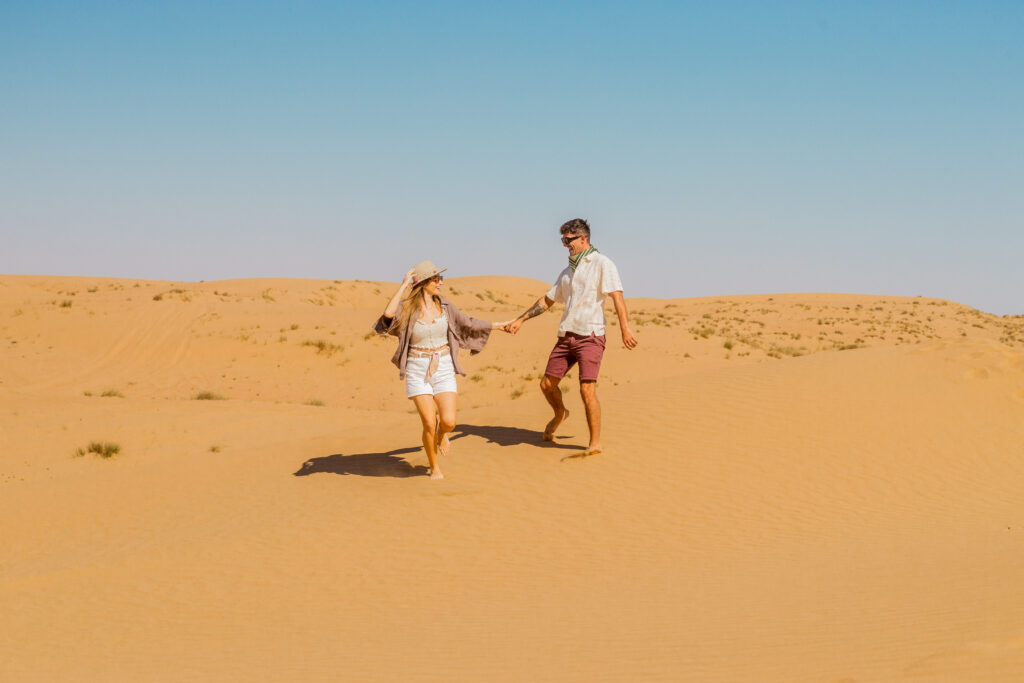
A couple walking across the open dunes of the Dubai desert at The Nest by Nara.

One of the first things guests notice at The Nest is the absence of urgency.

There is no sense of being moved quickly from one point to another.

No compressed arrival sequence. No pressure to rush through the first moments.

The tents are spaced apart. The desert remains visible in every direction. There is little to compete for attention.

And once that feeling of openness is established, it tends to remain for the rest of the stay.

As the Light Drops, the Desert Changes

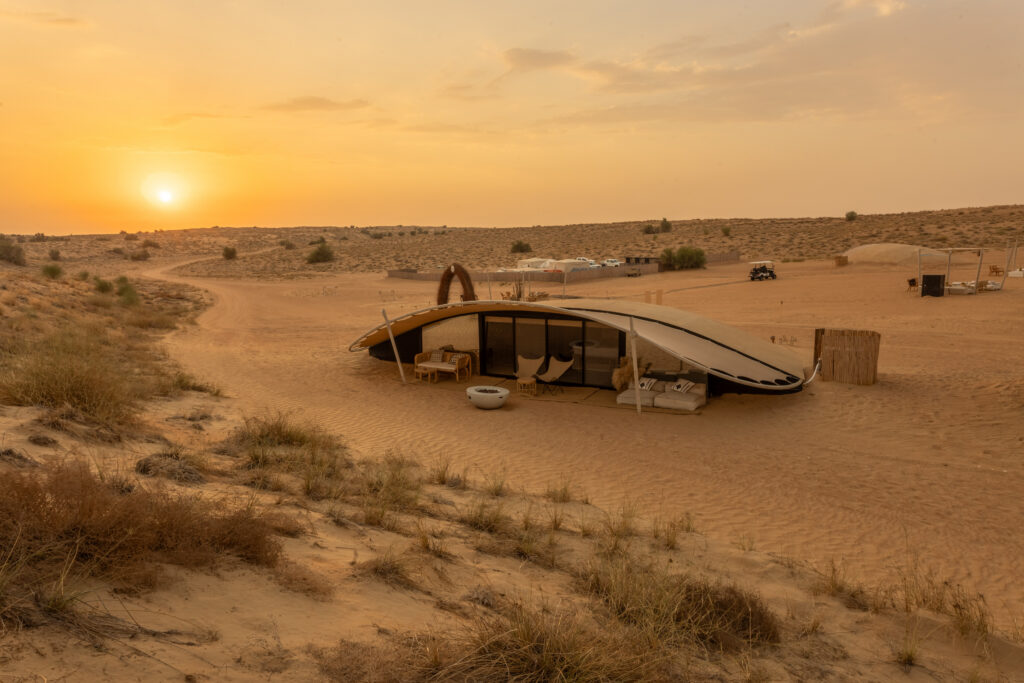
The Nest by Nara at sunset in Dubai.

The desert changes quickly once the sun begins to set. 

The temperature drops first. Then the colours of the sky begin to soften. The noticeable gold of the dunes give way to more muted tones. Shadows look less distinct..  I could go on. 

At the same time, sound becomes more noticeable.

Wind. Footsteps in the sand. Even the quiet feels loud. 

It is around this time that the desert starts to feel entirely different from the place guests arrived in earlier.

Less exposed.

More atmospheric.

More alive in quieter ways.

The Evening Has Structure, Without Feeling Structured

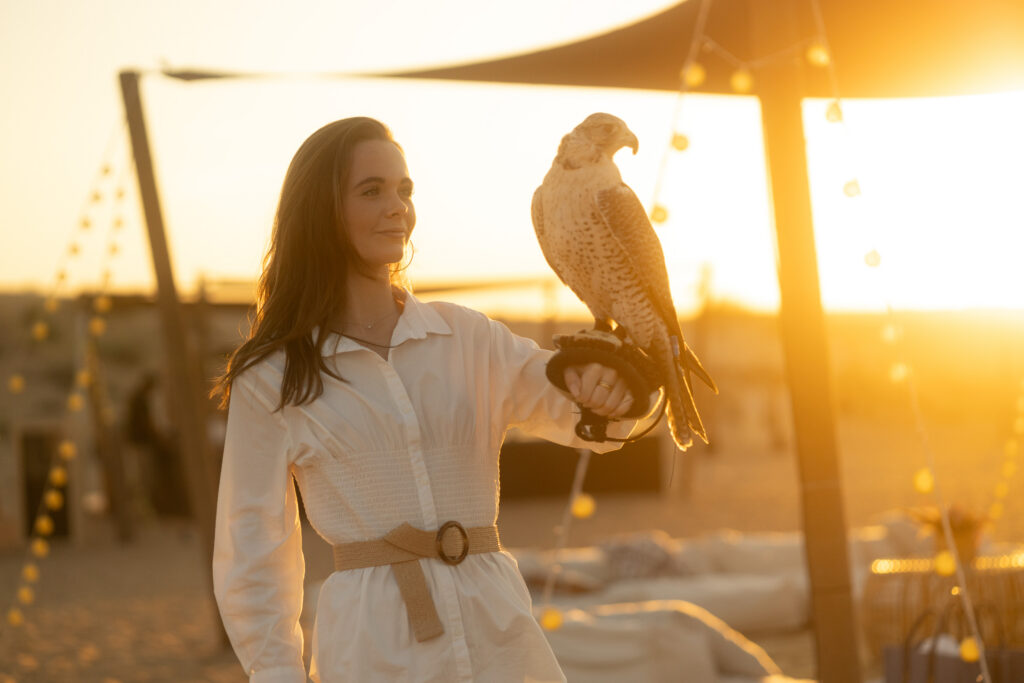
A lady holding a falcon in her arm at sunset, at The Nest in Dubai.

The evening follows a rhythm, but never feels tightly scheduled.

Your dinner arrives within the natural pace of the night.

Guests move between spaces as they choose.

Some choose to stay at the table longer.
Others move toward the fire.
Others walk out into the dunes for a moment before returning.

There is a sequence to the evening, but enough flexibility for it to feel personal.

At The Nest, the experience is guided without feeling managed.

Which allows the night to unfold naturally, rather than according to a visible itinerary.

What Happens After Dinner Matters More Than Most Expect

Sky Safari and stargazing at The Nest in Dubai.

Many assume dinner will be the focal point of the night.

In reality, what happens after tends to stay with people longer.

The walk back across the sand to your nest.
The flickering of the fire in the pit. 

Some guests remain near the lounge.
Others wander further out into the dark.
Many simply look up, noticing the stars appear brighter than they ever do in the city. 

It happens naturally, because once the desert quiets fully, looking upward becomes difficult to avoid.

Sleeping in the Desert

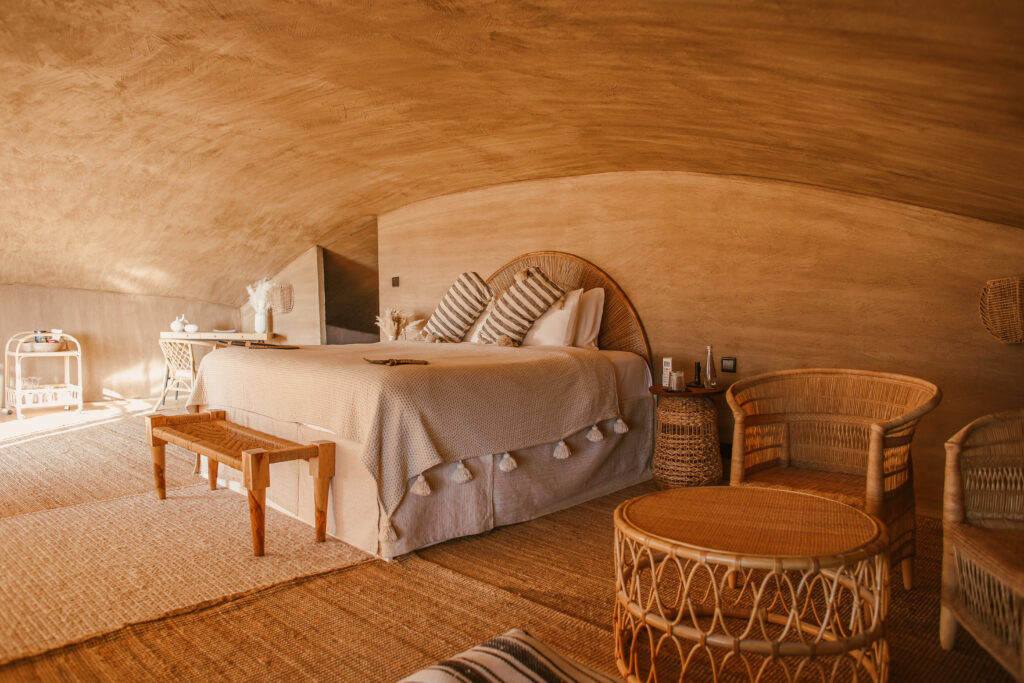
The interior of The Nest by Nara in Dubai.

This is often where expectations are lowest.. and where guests are most surprised.

Many arrive expecting sleeping in the desert to involve compromise.

The Nest was designed specifically to challenge that assumption.

The interiors are insulated and fully prepared.
The bedding is substantial.
The environment feels comforting rather than improvised.

It delivers the expectation of a premium overnight stay, while preserving the feeling of being fully in the desert.

Yet what guests tend to notice most is not the nest itself.. It is the silence.

The absence of background noise becomes more noticeable than the surroundings.

And many guests, myself included, sleep more easily than they expected to.

The Night Feels Longer Here

While it probably sounds like a cliché, time moves differently in the desert.

Without traffic, screens, or the usual signals of city life, the night just feels longer.

Not because more happens. Because less interrupts it.

Guests stay outside longer than intended.
Conversations continue longer than usual.
Moments that would pass quickly elsewhere tend to linger.

The experience feels extended simply because there is nothing rushing it forward.

Waking Before the Desert Heats Again

A family looking at the sunrise in The Nest in Dubai.

Morning in the desert arrives gently.

The first light is soft and diffused.

The air remains cool for a brief window before the temperature rises again.

Activity is minimal. The camp is quiet. Everything moves slowly.

Many guests wake earlier than they normally would, not because they need to, but because the landscape makes it difficult not to.

And those early morning moments often become one of the most memorable parts of the stay.

Because the desert at sunrise can feel like the first sunrise you have properly noticed in a long time.

What Stays With You After

What stays with most guests is rarely one singular moment.

Not dinner. Not the nest. Not even the sunrise.

It is the pace.

The way the evening stretched.
The way the silence changed everything.
The way the desert felt larger, yet still more comforting, at night than expected.

And often, it is only on the drive back into the city that the contrast becomes fully apparent.

That understanding has shaped The Nest from the beginning.

Because the point was never simply to create a place to sleep in the desert.

It was to create enough time for the desert to be properly felt.

Frequently Asked Questions

What is it like to sleep in the Dubai desert?

Sleeping in the Dubai desert is defined by stillness, silence, and a sense of space that feels very different after dark. The environment becomes more expansive at night, and the transition from evening to rest feels gradual rather than abrupt.

Is desert glamping in Dubai comfortable?

Comfort depends heavily on the setup. In more considered experiences such as The Nest, sleeping arrangements are fully prepared to deliver comfort without removing the feeling of being in the desert.

What is included in an overnight desert experience in Dubai?

Most overnight desert experiences include dinner, accommodation, and breakfast, but more considered stays often extend well beyond the basics. At The Nest, the evening can include time around the fire, guided stargazing, private cinema setups beneath the open sky, or experiences such as Sky Safari, where guests explore the desert night through astronomy-led storytelling and telescope observation. The result feels less like accommodation, and more like a fully shaped overnight experience.

Is sleeping in the desert safe in Dubai?

Yes. Overnight desert experiences are generally very safe when operated by licensed providers, with camps managed and monitored throughout the night.

What should you pack for an overnight desert stay?

Light layers, comfortable footwear, and minimal personal essentials are typically sufficient. Most luxury overnight stays provide the majority of what guests need.

Are overnight desert experiences worth it in Dubai?

For many guests, staying overnight offers a more complete experience of the desert than an evening visit alone. The difference is felt most in serenity, the slower pace, and the transition from night into morning.

Are children allowed on overnight desert stays?

Policies vary by provider, but some overnight desert experiences welcome families while others are adults-only. At The Nest, children are welcome, making it a suitable option for families wanting to experience the desert overnight together. For younger children and infants, cots can also be provided on request to make the stay more comfortable. To know more about booking a stay at The Nest for your family, contact us on info@sonara.ae or +971 50 336 7909.

Choosing Between a Dhow and Yacht Dinner Cruise in Dubai

A dinner cruise in Dubai can take many forms, but the experience varies significantly depending on the vessel.

For some, the appeal lies in the heritage and social energy of a traditional dhow. For others, it is the quieter, more private pace of a yacht that defines the evening.

Both offer a way to dine on the water. Both move through Dubai’s coastline in view of the city skyline. Yet the atmosphere, service style, privacy, and rhythm of the experience can feel entirely different.

For guests deciding between a dhow dinner Dubai experience and a yacht dinner Dubai experience, the right choice depends less on the vessel itself and more on the kind of evening being sought. This guide breaks down the differences between the two, from atmosphere and dining style to privacy and pacing, helping guests choose the best dinner cruise Dubai experience for the occasion.

Dhow vs. Yacht: Two Ways to Experience a Dinner Cruise in Dubai

At a glance, dhow and yacht cruises may appear to offer the same core experience: dinner served on the water while cruising through Dubai.

In practice, however, they create very different evenings.

A dhow dinner Dubai experience is typically centred around shared atmosphere. Guests board a traditional wooden vessel, dine in a communal setting, and follow a fixed route through Dubai Creek, Marina, or nearby waterways.

A yacht dinner Dubai experience is generally more contemporary in both setting and service. The atmosphere is often quieter, the design more minimal, and the pace less standardised.

For guests exploring dhow vs yacht Dubai options, the distinction is not simply aesthetic. It affects how the evening feels from arrival through departure.

Atmosphere: Social Energy vs. Private Space

A bustling dinner aboard Lady Nara in Dubai.

The atmosphere aboard each vessel differs immediately.

A dhow dinner cruise tends to feel more social by design. Most dhow experiences host multiple groups, creating visible movement throughout the vessel and a livelier shared environment. Music, entertainment, and guest interaction often form part of the wider atmosphere.

This makes dhow cruises appealing for guests who enjoy energy, activity, and a more communal setting.

A yacht, by contrast, offers a more contained environment.

Whether shared in a smaller group or booked privately, the setting feels quieter and more controlled. Space is less compressed. Movement is slower. The atmosphere centres more on the guest’s own company than on the wider room.

For those choosing between a dhow and yacht dinner cruise in Dubai, atmosphere is often the deciding factor before any other consideration.

Setting and Design: Traditional vs. Contemporary

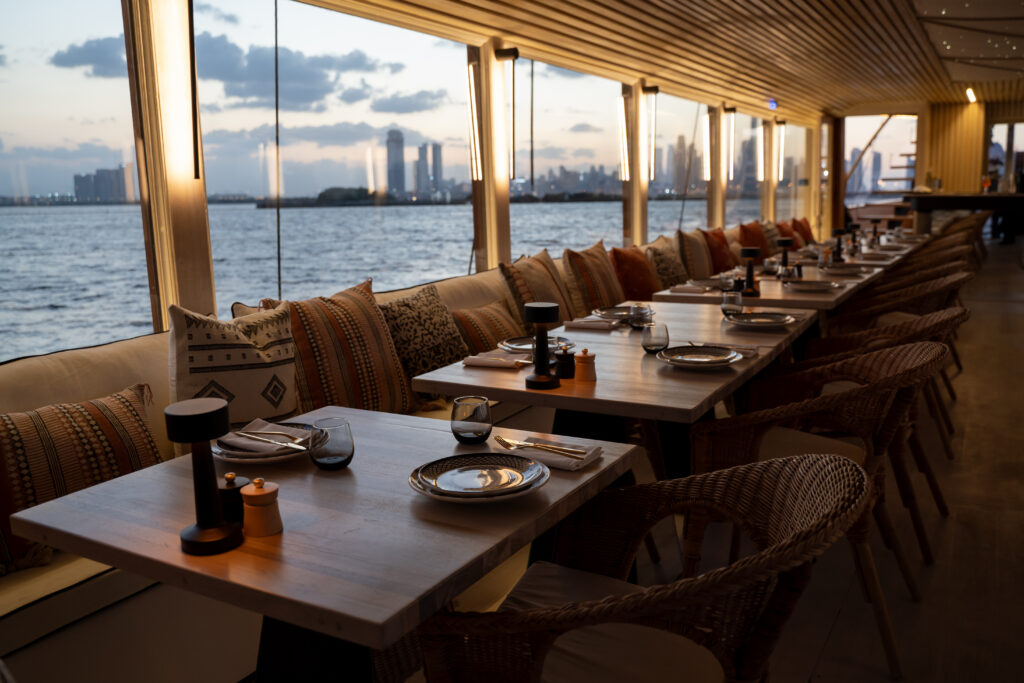
The ambience and decor inside the lower deck of Lady Nara in Dubai.

Design shapes perception before the evening has even begun.

A dhow carries cultural and historical reference. Traditionally built in wood, with enclosed dining decks and heritage-inspired detailing, the setting evokes an older maritime side of Dubai.

For many visitors, this heritage feel is part of the appeal.

A yacht offers a more contemporary aesthetic.

Open decks, cleaner architectural lines, and more minimal finishes create a setting that feels more modern and design-led. The experience often feels less themed and more understated.

For guests drawn to atmosphere through visual design, this distinction can strongly influence preference.

Dining Style: Buffet vs. Curated Service

The way dinner is served changes the tone of the evening more than many expect.

Most dhow dinner cruises in Dubai operate with buffet-style dining. Guests serve themselves from a shared spread, often within a structured service window that follows the cruise schedule.

This format suits the scale and communal nature of the dhow experience.

Yacht dining tends to allow for more flexibility.

Depending on the operator and format, meals may be plated, chef-led, or tailored to the group. Service is often paced around the guest rather than the vessel’s operational schedule.

For guests where dining is central to the evening rather than simply part of it, the yacht format often feels more considered.

Experiences such as Lady Nara reflect this shift, combining the intimacy of yacht dining with a more curated culinary approach.

Pacing of the Evening: Fixed Route vs. Flexible Timing

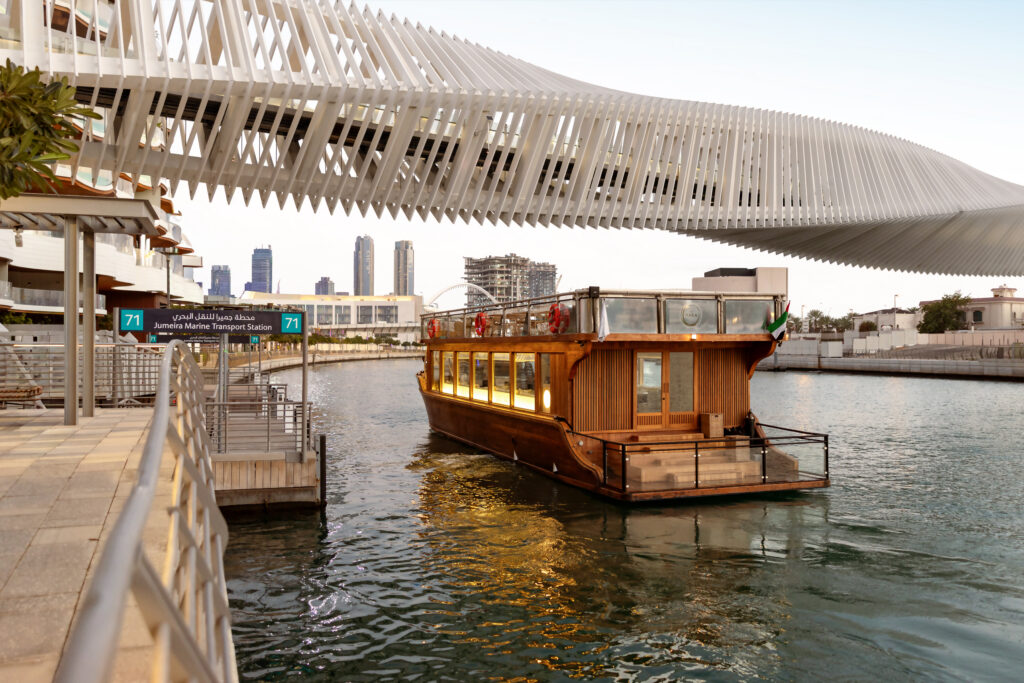
Lady Nara departing from the Jumeirah Marine Station in Dubai.

The structure of the evening differs significantly between formats.

A dhow cruise typically follows a fixed operational schedule. Boarding begins at a set time, departure follows shortly after, and the route and duration remain largely unchanged from one sailing to the next.

This creates predictability and consistency, but less flexibility.

A yacht experience often allows for greater fluidity.

Routes may vary. Timing can be adjusted depending on the charter or operator. The evening can move more naturally, with space for pauses, slower progression, or extended moments where appropriate.

For guests seeking a more flexible Dubai dinner cruise experience, this can materially change how relaxed the evening feels.

Privacy and Group Size: Shared Experience vs. Exclusive Use

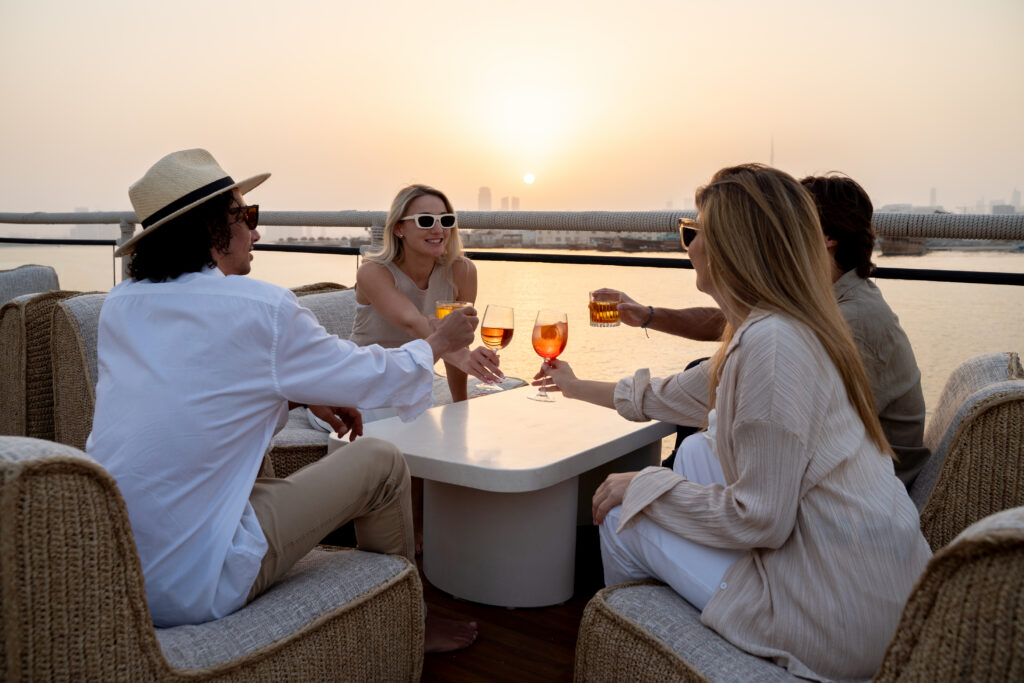
A group of 4 enjoying cocktails at sunset aboard Lady Nara in Dubai.

Privacy is one of the clearest distinctions between dhow and yacht formats.

Dhow cruises generally accommodate larger guest numbers, often with shared seating or closely spaced tables. Even where tables are separate, the environment remains communal.

Yachts provide more control over space.

Some operate with intentionally limited guest counts. Others are available as private yacht dinner Dubai experiences, allowing guests full exclusivity over the vessel.

For proposals, milestone celebrations, client hosting, or private occasions, this difference can significantly shape the suitability of the format.

How Each Setting Changes the Occasion

The same evening can feel entirely different depending on the vessel selected.

For Couples

A couple looking over the Dubai skyline at sunset, aboard Lady Nara in Dubai.

Couples seeking privacy, slower pacing, or a more intimate atmosphere often gravitate toward yacht settings, particularly for anniversaries or romantic occasions.

A dhow may suit couples who enjoy shared atmosphere and a livelier environment.

For Celebrations

For birthdays, informal gatherings, or celebrations where energy matters more than exclusivity, a dhow can create a more animated atmosphere.

For milestone celebrations where the evening itself is intended to feel more elevated, a yacht often aligns better.

For Small Groups

Smaller groups often benefit from the intimacy and flexibility of a yacht, particularly where conversation and hosting are central to the evening.

Even for small groups, the scale of the setting changes the way the night feels.

For Corporate Gatherings

Larger hosted groups may find dhow cruises operationally efficient for broader entertainment.

More private executive hosting or client-facing occasions may suit a yacht’s exclusivity better.

Choosing Based on the Evening You Want

Ultimately, the right choice comes down to how the evening is meant to feel.

Guests seeking:

  • Shared atmosphere
  • Cultural character
  • Structured pacing
  • More social energy, may prefer a dhow dinner cruise.

Guests prioritising:

  • Privacy
  • Flexibility
  • Design-led surroundings
  • A quieter, more curated pace, may find a yacht more aligned with the occasion.

For those looking for a more elevated interpretation of a yacht dinner Dubai experience, offerings such as Lady Nara provide a more considered approach, pairing the privacy of yacht dining with slower pacing and curated service.

Because when choosing between dhow and yacht, the vessel matters less than the feeling the evening is meant to create.

Frequently Asked Questions

What is the difference between a dhow and a yacht dinner cruise in Dubai?

A dhow offers a more traditional, communal dining experience aboard a heritage-style wooden vessel, while a yacht provides a more contemporary setting with greater privacy, flexibility, and often more tailored service.

Is a dhow dinner cruise suitable for couples?

Yes. Many couples enjoy dhow cruises for their atmosphere and traditional character. For those seeking greater intimacy, more refined dhow-style experiences such as Lady Nara offer a more private and design-conscious alternative.

Are yacht dinner cruises private in Dubai?

Some are fully private, while others operate shared formats with limited guest counts. Private yacht dinner experiences are widely available for guests seeking exclusivity.

Which dinner cruise is better for special occasions?

For birthdays, anniversaries, proposals, or private celebrations, yacht cruises are often preferred for their privacy and flexibility. Guests seeking a similarly intimate atmosphere in a more curated shared setting may also consider refined on-water experiences such as Lady Nara in Dubai.

What is included in a Dubai dinner cruise?

Most dinner cruises include the cruise itself, dining service, and onboard hospitality. Inclusions vary depending on the operator and format selected.

Are dinner cruises in Dubai worth it?

For guests wanting to combine dining with waterfront views and a more immersive setting, dinner cruises remain one of Dubai’s most distinctive evening formats, particularly when the experience is thoughtfully curated rather than purely tour-led.

Is alcohol served on dhow and yacht dinner cruises in Dubai?

This varies by operator. Some licensed experiences serve alcohol, while others do not.

5 Ways to Propose in the Dubai Desert: Settings That Change the Moment

There are few places in Dubai where a proposal feels naturally removed from everything else.

The desert is one of them.

Distance changes the way the moment lands. The pace slows. The setting strips away distraction. What remains is space, stillness, and a sense that the evening exists outside of ordinary time.

At Nara, the team has helped shape hundreds of desert proposals over the years, each designed differently depending on the couple, the setting, and how the moment is meant to unfold.

For those planning a desert proposal in Dubai, these are five of the most compelling ways to do it.

Why the Desert Changes the Way a Proposal Is Felt

A desert proposal in Dubai feels different before the proposal has even happened.

The drive out creates separation from the city. The environment quiets. The pace slows naturally.

Unlike many proposal venues in Dubai, the desert does not need to be heavily styled to feel significant.

Its scale does much of the work on its own.

At Nara, this is often what couples respond to most. Not just the setup itself, but the way the setting changes how the moment is experienced.

The Five Ways at a Glance

  1. A sunset proposal on arrival
  2. A private dinner proposal beneath the stars
  3. A proposal timed with the Sonara show
  4. A proposal by the fire after dinner
  5. An overnight proposal at The Nest

1. A Sunset Proposal on Arrival

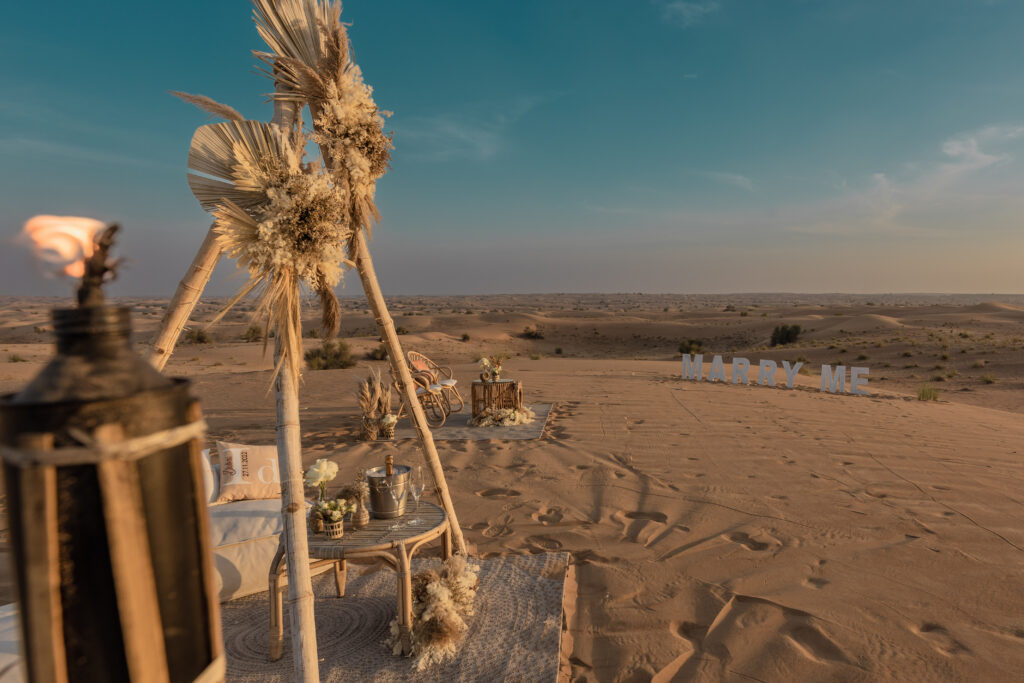
A sunset proposal set-up at Nara desert experiences in Dubai.

For couples who want the moment to happen before anticipation has time to build, a sunset proposal on arrival remains one of the most striking formats.

The proposal takes place shortly after reaching the desert, timed with the final light of day as the dunes shift into gold.

There is little buildup. No prolonged waiting. No staged lead-in.

This is often chosen by couples who want the proposal to feel instinctive and immediate, with the setting carrying the atmosphere naturally.

2. A Private Dinner Proposal Beneath the Stars

A couple looking over the Sonara Camp beneath the stars in Dubai.

For those wanting the proposal to unfold more gradually, a private dinner remains one of the most timeless ways to propose in the Dubai desert.

The evening begins as dinner. The proposal emerges later, when the timing feels right.

It may happen before the first course, between courses, or once the meal has settled.

Private desert dining at Nara allows the evening to be paced entirely around the couple, with dedicated setups designed for privacy and slower progression.

3. A Proposal Timed with the Sonara Show

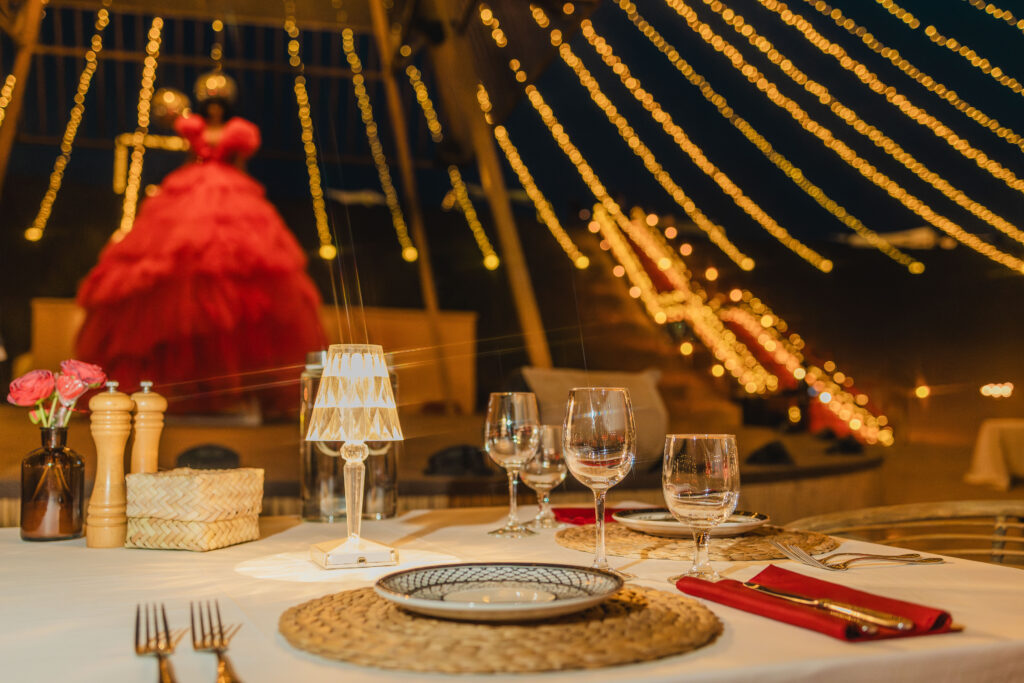
The table set up for a romantic dinner and a show at Sonara Camp in Dubai.

For couples who want a more dramatic and immersive proposal, some choose to time the moment around the Sonara show itself.

The proposal is integrated into the wider rhythm of the evening, often following a key performance or timed with a major shift in atmosphere.

This format suits couples who enjoy energy and spectacle, and who want the proposal to feel part of a larger shared experience.

When planned carefully, the contrast between performance and proposal creates a memorable shift in the night.

4. A Proposal by the Fire After Dinner

Not every proposal needs to happen at the height of the evening.

For some couples, the strongest moment comes later, once dinner has ended and the night has softened.

A proposal by the fire creates a more relaxed setting, often feeling quieter and more natural than a formal reveal.

5. An Overnight Proposal at The Nest

Luxury overnight desert sanctuary at The Nest in Dubai.

For those wanting the proposal to sit within a longer experience, an overnight stay at The Nest offers one of the most immersive ways to propose in the Dubai desert.

The proposal can happen before check-in, during dinner, by the fire, beneath the stars, or the following morning at sunrise.

What makes this format different is that the evening does not end after the question.

The proposal becomes part of a full overnight memory rather than a single isolated moment.

What Actually Matters When Planning a Proposal in the Desert

The most successful proposals are rarely the most elaborate.

What matters more is timing.

A proposal planned around the natural rhythm of the evening will almost always feel stronger than one built around excessive setup.

Privacy matters too.

For some couples that means full exclusivity. For others, it simply means enough space for the moment to feel self-contained.

And perhaps most importantly, coordination matters.

The smoother the logistics behind the scenes, the less staged the proposal feels in the moment.

Choosing the Right Setting for the Moment

A couple spending intentional, uninterrupted time together at Nara desert experiences.

The best proposal format depends less on what photographs well and more on how the couple wants the moment to feel.

Some want immediacy.
Some want anticipation.
Some want privacy above all else.
Others want the proposal to sit within a wider shared experience.

At Nara, proposals are shaped around those differences rather than forced into one format.

Because the setting matters. But how the moment unfolds matters more.

Frequently Asked Questions

Where can I propose in the Dubai desert?

Several proposal venues in Dubai offer desert proposal experiences, though the level of privacy and curation varies significantly. Nara offers proposal settings across Sonara, private dining setups, and overnight experiences at The Nest.

Is a desert proposal private?

It can be entirely private, depending on the format you choose. At Nara, proposals can be arranged in dedicated setups positioned away from other guests, with the level of privacy tailored to the kind of moment you want to create, whether that means complete seclusion or simply more space around you.

Can a proposal be arranged during a desert dinner?

Yes. Many couples choose to integrate the proposal into a desert dinner experience. At Nara, proposals can be built into the pacing of the evening so the moment feels natural rather than staged.

Are desert proposals suitable for small groups or just couples?

Both. While many desert proposals are designed as private moments for two, Nara can also accommodate small groups for those who want family or close friends to be part of the celebration. The format can be tailored depending on whether the group is involved in the proposal itself or joins afterward to continue the evening.

How far in advance should a proposal be planned in Dubai?

Ideally several weeks in advance, particularly for bespoke or private proposal setups requiring additional planning.

Eating Outside in Dubai, and Why It Took Us This Long to Get It Right

The first time I understood the season

The first time outdoor dining in Dubai made sense to me — not as a concept but as something I felt in my chest — was a December evening at a table set on sand. It was just after seven. The temperature had dropped to twenty-three degrees, and the air had that particular weight it carries in the desert when the sun is gone but the earth is still warm. There was no wall between me and the horizon. No glass. No railing. Just a table, a plate of lamb that had been cooking slowly since afternoon, and a silence so complete I could hear the person next to me swallow their wine.

I had lived in this city for years by then. I had eaten on terraces with misting systems in September, sweating through courses I could not taste because my body was busy surviving. I had done rooftop brunches in May where the bread dried out between the basket and my plate. I had confused proximity to the outdoors with actually being outside.

That December night was different. The wind came from the east, slow and cool, carrying nothing. The sky had already turned from copper to ink. The food was good — it is almost always good when the kitchen has room to breathe — but what I remember is the temperature. Twenty-three degrees at seven in the evening. The kind of air that makes you sit back in your chair and stay.

That was the first time I understood that Dubai does not have a dining season. It has a reprieve.

Seven months of waiting

From April to October, Dubai folds inward. Restaurants seal their terraces. Hotels retract their poolside menus. The city, which markets itself on spectacle and openness, spends more than half the year behind glass. The heat is not an inconvenience, it is an erasure. At forty-six degrees, the question of eating outside does not come up. You do not weigh the pros and cons. In this case you simply do not go.

This compression does something to you. By the time October comes and the air starts to thin, there is an urgency that people in temperate cities never feel. The first cool evening is not casual. It is an event. Restaurants that have been half-empty suddenly cannot seat you. Terraces fill before the dining room. People stand on balconies with their morning coffee for the first time in seven months, and they stand there longer than they need to.

The season is not long. November through March – five months if you are generous, four if you are honest. And that brevity is exactly what makes it matter.

What the desert does to a meal

There is a moment at Sonara Camp, maybe forty minutes before sunset, when the kitchen begins to work and the smoke rises straight up because there is no wind yet. The camp sits inside the Dubai Desert Conservation Reserve, far enough from the highway that you cannot hear it, far enough from the city that you cannot see it. The kitchen operates kilometres from the nearest permanent structure. Everything – the ovens, the cold storage, the prep stations – has been brought here, assembled on sand, and will perform as though it were not absurd to cook a five-course dinner in the middle of a desert.

That absurdity is part of it. Eating well in a place that offers nothing – no infrastructure, no shelter, no audience – forces a kind of attention that a city restaurant cannot. You notice the food because there is nothing else to notice. The lamb shoulder, pulled apart at the table, tastes the way it tastes because the air is dry and still and carries the smoke directly to you before the fat has cooled. The bread, charred on one side from an open flame, is warm in your hands in a way it never is when it arrives on a plate carried from a kitchen down a hallway through a swinging door.

This is one of the more honest unique dining experiences Dubai has produced. Not because it is more expensive or more exclusive, but because the desert strips away the architecture that usually separates you from your meal. There are no walls to absorb sound, so conversation carries. Laughter from three tables away reaches you intact. The clink of a glass is specific, not muffled.

During dinner, when the lights dim, you look up. The stars in the Conservation Reserve are not the stars you see from a Dubai rooftop. They are brighter, denser, older-looking, indifferent. The meal is over, but the desert is not finished with you.

What the sea does to a meal

A meal on Lady Nara begins before you sit down. It begins when the dhow pulls away from the marina and the skyline starts to move. The Burj Khalifa, which from land is a fixed point you stop noticing, becomes a thing that drifts. It slides behind the Frame, reappears between two towers you have never paid attention to in Business Bay, and eventually settles into a silhouette that looks nothing like the postcard. The city rearranges itself for you, and you have not yet been handed a menu.

Water changes the contract between a diner and a meal. On land, you sit still and the food comes to you. On the Gulf, everything is in motion — the boat, the skyline, the light on the surface, your own centre of gravity making micro-adjustments you are not aware of until you reach for your glass and find it has shifted two centimetres to the left. This is not disorienting. It is engaging. Your body is involved in the meal in a way it usually is not.

The salt air does something to flavour. I have no scientific explanation for this, only repetition. A gin and tonic on the deck of a yacht in the Arabian Gulf tastes different from the same gin and tonic at a bar. Sharper. Colder, even when it is not. The seafood — grilled prawns, sea bass with skin that crisps in the open air — carries the environment into the plate. You taste the place.

This is, in the most literal sense, the best dining experience Dubai offers from the water: a city you thought you knew, seen from a distance that makes it new, while you eat food that has been improved by the simple fact of where you are eating it. The wind is constant. The light, reflected off the Gulf, is different every fifteen minutes. Nothing is controlled, and nothing needs to be.

Private dining setup inside Lady Nara featuring elegant tables arranged for an intimate sea experience.

The restaurants are not the point

If you search for the best outdoor restaurant Dubai has to offer, you will find lists. Dozens of them. They will rank terraces by view, by price, by Instagram performance. They will tell you where to sit, what to order, which angle to photograph. They will treat the restaurant as the destination and the outdoors as the backdrop.

They have it backwards.

The best outdoor dining happens at the collision between food and place — when the setting is not decoration but ingredient. A restaurant in the desert is not a restaurant with a desert view. It is a restaurant that the desert has altered. The silence, the temperature, the distance from everything familiar — these change what the food means. A restaurant on the water is not a restaurant with a sea breeze. The motion, the salt, the shifting horizon — these are part of the menu.

Dubai is specific. It is not a Mediterranean coast where outdoor dining is a default. It is not a tropical island where the weather permits it year-round. It is a city that earns its outdoor season through months of enforced patience, and that specificity — the compression, the relief, the intensity of a short window — is what makes eating outside here feel different from eating outside anywhere else.

The best outdoor restaurant in Dubai is not a single address. It is whatever table, in whatever setting, on whatever evening the air finally cooperates and the food meets the place halfway.

When to go (and when not to)

The core season runs from November through March. These are the months when you can sit outside at seven in the evening without thinking about the temperature, because the temperature is not asking anything of you. December and January are the centre — evenings around twenty to twenty-three degrees, the air dry and still, the light at golden hour lasting long enough to mean something.

October and April are shoulder months, and they require strategy. Early October evenings can still hold thirty degrees at sunset. Late April can surprise you with a cool night, but you are gambling. The desert is best from November to February, when the temperature drops sharply after sunset and the stars are at their clearest — the kind of outdoor restaurants Dubai with a view that no architect can design. The sea is best in December and January, when the Gulf is calm and the wind is present but not aggressive. The city works any time the season is open, but peaks in January, when the tourist energy and the cool air converge.

If you are choosing one month, choose January. If you are choosing one evening, choose a Thursday. The city exhales on Thursday evenings, and the outdoor tables fill with people who look like they have been waiting all week to sit exactly where they are sitting.

What outdoor dining in Dubai will look like in five years

The desert will still be there. The Gulf will still be there. The season will still be short, and that compression will still do its work on the people who live here.

What will change is the ambition. Restaurants are already moving further into the desert, deeper into the Conservation Reserve, further from the marina into open water. The Nest has already extended the desert experience past dinner and into the morning — you sleep in the dunes and wake to a silence that makes the previous night feel like a memory you are still inside. Others will follow. The line between dining and dwelling will continue to blur.

Five years from now, the lists will be longer. The terraces will multiply. The views will get more dramatic. But the thing that makes outdoor dining in Dubai what it is — the heat you survived to get here, the cool air you waited seven months to feel, the meal that tastes the way it tastes because of where you are — that will not change.

Some things about a city are structural. The season is one of them.

Frequently Asked Questions

When is the best time for outdoor dining in Dubai?

The best months for outdoor dining in Dubai are November through March, with December and January as the peak. During these months, evening temperatures range from twenty to twenty-four degrees Celsius — comfortable enough to sit outside for hours without air conditioning or misting systems. October and April are shoulder months where some evenings work and others do not, depending on the weather that week. For desert dining, November through February offers the most dramatic temperature drop after sunset and the clearest night skies. For yacht dining on the Gulf, December and January provide the calmest seas and the most comfortable wind. City terraces are enjoyable throughout the full November-to-March window.

Which outdoor restaurants in Dubai have the best views?

The answer depends on what you consider a view. Sonara Camp, located inside the Dubai Desert Conservation Reserve, offers an uninterrupted horizon of dunes with no buildings, roads, or artificial light. The kind of view that changes minute by minute as the sun sets and the stars appear. Lady Nara provides a moving view of the Dubai skyline from the Arabian Gulf, where the city rearranges itself as the dhow travels. The most honest answer is that the best views in Dubai outdoor dining are not skyline panoramas from the seventy-second floor. They are ground-level encounters with the desert, the sea, or the street.

Are there outdoor restaurants in Dubai suitable for families?

Yes. Desert dining at Sonara Camp works well for families with older children who can appreciate the quiet and the scale of the setting — younger children may find the silence and the distance from familiar surroundings challenging. Dhow cruise and yacht dining on Lady Nara is best suited to older children and teenagers who are comfortable on water. For families with young children, the city terrace is the safest choice: accessible, stimulating, and forgiving of restlessness.

What makes outdoor dining in Dubai different from other cities?

Two things. First, the season is compressed. Dubai offers only four to five months of genuinely comfortable outdoor dining, compared to eight or nine in Mediterranean or tropical cities. That compression creates urgency — residents treat outdoor meals as events, not defaults. Second, the range of settings is extreme. Within a single city, you can eat dinner on a sand dune in a nature reserve, on the deck of a yacht in the Arabian Gulf, or at a street-side table in a busy neighbourhood. Few cities offer that variety of landscape within such a short drive. The combination of scarcity and range makes outdoor dining in Dubai feel more deliberate and more valued than in places where it is available year-round.

Sonara Camp, Lady Nara, and The Nest are open for the season. The Journal publishes new stories every week.

What to Expect From Desert Dining in Dubai

Dubai offers no shortage of places to eat well. But desert dining in Dubai is not simply about the meal.

What draws people into the dunes is rarely the food alone. Perhaps surprisingly, it is the shift in pace, the distance from the city. The way an ordinary dinner begins to feel more considered and intentional when it happens somewhere with open space around it.

A desert dinner in Dubai can take many forms, from larger safari-style setups built around activity to quieter, more curated evenings where the environment itself becomes part of the experience. Knowing the difference matters. Not every desert dining experience is designed in the same way, and the one you choose will shape how the evening feels.

For those considering a Dubai desert dinner experience, here is what to expect, how formats differ, and how to choose the setting that suits the kind of evening you actually want.

What Desert Dining in Dubai Actually Feels Like

The first thing most people notice is that the experience begins before dinner does.

Part of desert dining in Dubai is the transition itself. Leaving the city behind, watching the roads thin out (and the city traffic subside), and arriving somewhere where the horizon opens.

The pace shifts naturally. There is less movement. Less noise. Less urgency.

That change in environment is what separates a desert dinner from simply dining al fresco. 

In the right setting, the evening is not built around activity or spectacle. It is built around atmosphere. The meal is one part of a wider experience shaped by light, sound, distance, and the way the desert changes after sunset.

This is why many guests remember the feeling of the evening before they remember what they ate.

Types of Desert Dining Experiences in Dubai

Not all desert dining experiences in Dubai are designed in the same way. The format you choose will determine whether the evening feels social, private, energetic, or slow.

Traditional Safari-Style Dinners

Dune bashing in a 4x4 in the Dubai desert with Nara Desert Experiences.

This is the format many visitors know first, tourists especially. 

Traditional safari dinners are typically part of larger desert safari packages, combining dune driving, short activities, buffet dining, and live entertainment, often some variation of belly dancing, in one structured itinerary.

These experiences are often designed for volume and variety. They suit guests looking to experience several elements of the desert in a single evening, but the pace tends to be fixed and the setting more communal.

Private Desert Dining

A couple sharing an intimate and private date under the stars at a Nara desert experience.

Private desert dining in Dubai offers more control over the environment.

Rather than joining a larger group, guests are seated in a dedicated setup away from shared dining areas, with the evening shaped around their own pace.

This format tends to suit couples, proposals, smaller celebrations, or guests who value privacy over activity.

The focus shifts from entertainment-led programming to atmosphere, conversation, and time spent in the setting itself.

Curated Multi-Course Experiences

A refined multi-course menu featuring Black Angus beef tagliatta, lamb chops, and more, served at Nara’s luxury desert dining experience in Dubai.

A more curated luxury desert dinner Dubai experience sits somewhere between the two.

These evenings are typically built around progression rather than a single meal, with movement through different spaces, more considered food and beverage service, and entertainment or performance integrated more selectively.

Rather than treating the desert as a backdrop, the setting becomes part of the design of the evening itself.

This is where desert dining becomes less about “having dinner in the desert” and more about the full experience around it.

What to Expect from a Desert Dinner Experience

For those booking a desert dinner in Dubai for the first time, the evening usually unfolds over several hours rather than around a single seating.

Most experiences begin in the late afternoon or early evening, timed to allow for arrival before sunset.

From there, the night generally moves through arrival, drinks or settling-in, dinner, and then entertainment or quieter post-dinner moments depending on the format.

Food and service styles vary significantly.

Some desert dining experiences centre around buffet service and shared dining environments. Others offer plated courses, paired drinks, or more tailored service depending on the setup.

Entertainment also differs.

In larger camps, live performances often form part of the evening. In more curated experiences, entertainment tends to be integrated more lightly, used to shape the atmosphere rather than dominate it.

The overall duration is usually between three and five hours, though private and extended experiences may continue longer.

What to Wear to a Desert Dinner in Dubai

What to wear to a desert dinner in Dubai depends partly on the season, but the same principles apply year-round.

Comfort matters more than formality.

Footwear should be suitable for sand. Heels and overly delicate shoes rarely work well in the desert, particularly if the evening involves moving between spaces.

Evenings can cool significantly after sunset in winter, so light layering is worth planning for.

The setting generally calls for clothing that feels considered without being overly formal.

Most guests dress somewhere between elevated casual and occasion wear, depending on the nature of the evening.

The aim is to feel comfortable enough for the environment while still respecting the setting.

When Desert Dining in Dubai Feels Most Worth It

A birthday celebration taking place at Sonara Camp Dubai.

Desert dining tends to feel most memorable when the occasion suits the setting.

For couples, the desert offers privacy and atmosphere that city restaurants often cannot.

For families, it creates a sense of occasion without requiring over-structuring.

For birthdays, anniversaries, and celebrations, the environment naturally elevates the evening without needing excessive staging.

Even for small groups, the scale of the setting changes the way the night feels.

Timing also matters.

A sunset arrival offers the most dramatic transition, allowing guests to experience the desert in changing light.

Night arrivals create a different atmosphere entirely, quieter and more intimate from the outset.

The right choice depends less on what looks best, and more on the type of evening you want to have.

Frequently Asked Questions

What is included in a desert dining experience in Dubai?

Most desert dining experiences include transport to the desert, dinner, and access to the wider setting or camp. More premium formats may also include drinks, entertainment, or additional experiences integrated into the evening.

How long does a desert dinner last?

Most desert dinner experiences in Dubai last between three and five hours, depending on the format and level of curation.

Is desert dining suitable for couples?

Yes. Many couples choose desert dining for the privacy and atmosphere it offers, particularly in more curated or private settings.

What should I wear to a desert dinner?

Comfortable, breathable clothing and footwear suitable for sand are recommended. Light layers are useful during cooler months in Dubai.

Is alcohol served during a desert dining experience in Dubai?

Alcohol is available at licensed desert dining experiences, such as Sonara Camp and other Nara desert experiences, and is typically integrated into the meal or wider dining progression.

Can you book a private desert dinner in Dubai?

Yes. Private desert dining is available in Dubai through selected operators offering dedicated setups or exclusive-use experiences. Nara also offers private desert dining experiences designed around pacing, privacy, and the setting itself for guests seeking a more considered evening.
Explore private desert dining with Nara by contacting us on info@sonara.ae or +971 50 336 7909.

Is there entertainment during a desert dining experience in Dubai?

Yes. Many desert dining experiences include live entertainment, though the style and scale vary widely. At Sonara Camp and other Nara desert experiences, evenings may feature live musicians, immersive desert performances, and signature fire shows, all designed to complement the setting and pacing of the experience rather than overwhelm it.

Is desert dining in Dubai suitable for children?

Yes. Many desert dining experiences in Dubai are family-friendly, though the atmosphere and format can vary. At Sonara Camp, desert dining is designed to accommodate families, with dedicated children’s areas during dinner and activities that keep younger guests engaged throughout the evening. Popular experiences include camel riding, sandboarding, henna art, soft archery, volleyball, marshmallow roasting around the firepit, and movies under the stars, making the desert especially memorable for children while allowing adults to enjoy the evening at their own pace.

Contact

Desert and Sea Experiences

PRIVATE EVENTS & CATERING SERVICES

Book

DESERT EXPERIENCE

SONARA CAMP

VOYAGE

LADY NARA

OVERNIGHT STAY

THE NEST BY NARA

DESERT • SEA • CITY